From P1 registration and Phase 2B to recess, pocket money, student care and those unexpected no-school days — here’s what our first year actually taught me.
If your child is entering Primary 1 in Singapore next year, congratulations.
And also… welcome to a completely new stage of parenting. 😂
My eldest started Primary 1 this year, and before school began, I spent so much time thinking about the things I thought were important:
Which primary school should we choose?
Will we need to ballot?
Which P1 registration phase are we eligible for?
Is he academically ready?
Then school actually started.
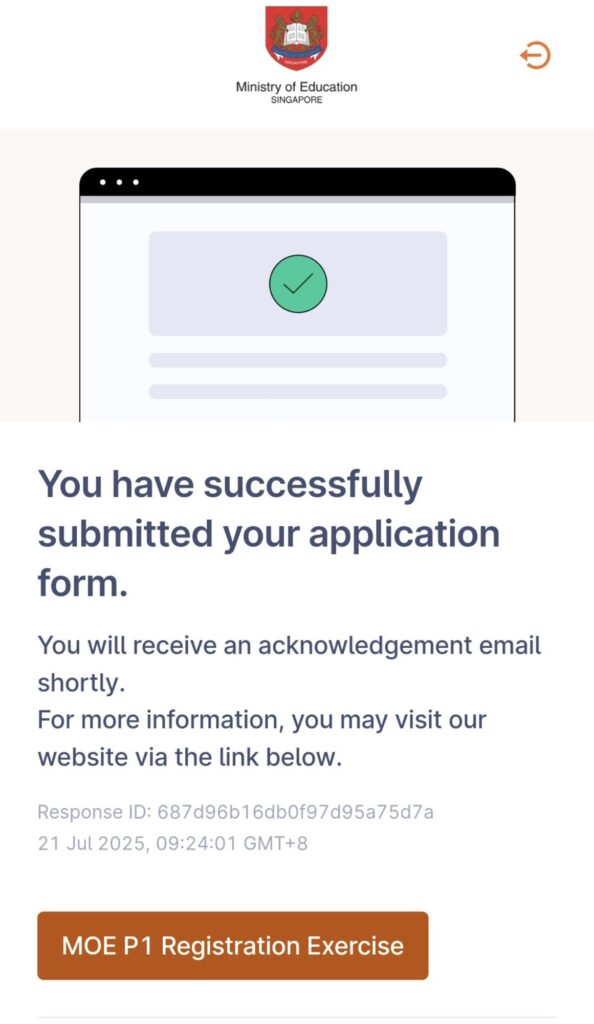
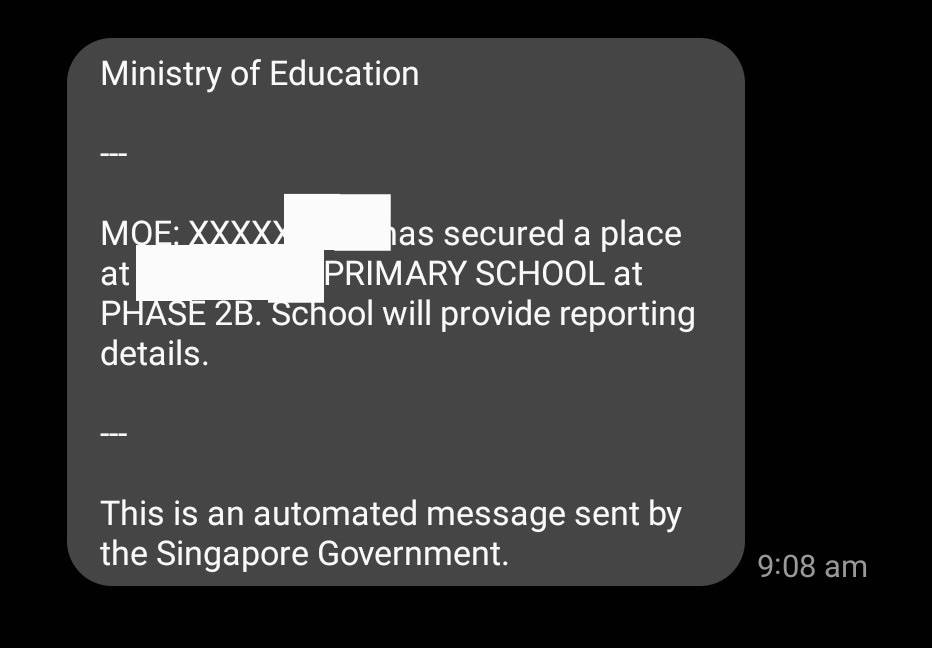
And I realised that securing the school was really just Step One.
Suddenly I had a whole new set of questions.
Will 30 minutes of recess actually be enough for him to queue, buy food and eat?
How much pocket money should a P1 child bring?
Cash, EZ-Link or smart watch?
Should I pack recess for him?
What happens if he gets hurt and doesn’t tell anyone?
Do we really need student care?
And the one working parents really need to know:
Why are there so many weekdays where primary school children don’t need to report?!
So this isn’t going to be another generic “buy a school bag and practise waking up early” P1 checklist.
This is everything I wish someone had explained to me before my own child entered Primary 1 — from P1 registration and Phase 2B to recess, independence, student care and childcare planning.
If your child is starting P1 or you’re planning even further ahead, I hope this makes the transition a little less daunting.
1. Before Primary 1: Understanding P1 Registration in Singapore
For Singapore Citizens and Permanent Residents, the P1 Registration Exercise takes place the year before your child enters Primary 1.
MOE’s current P1 registration process for SCs and PRs is conducted online and consists of five main phases: Phase 1, Phase 2A, Phase 2B, Phase 2C and Phase 2C Supplementary.
Here’s the easiest way I would explain them to a first-time parent.
Phase 1
Child has a sibling currently studying in the primary school
Phase 2A
Eligible former students/alumni connections, school staff, School Advisory/Management Committee members and eligible MOE Kindergarten children
Phase 2B
Eligible parent volunteers, endorsed church/clan members and endorsed active community leaders
Phase 2C
Children who have not yet secured a P1 place
Phase 2C Supplementary
Children still not registered after Phase 2C
MOE’s eligibility rules should always be your final reference because requirements can change.
👉 Check the latest P1 registration information here:
Our Phase 2B Experience: Singapore Hokkien Huay Kuan
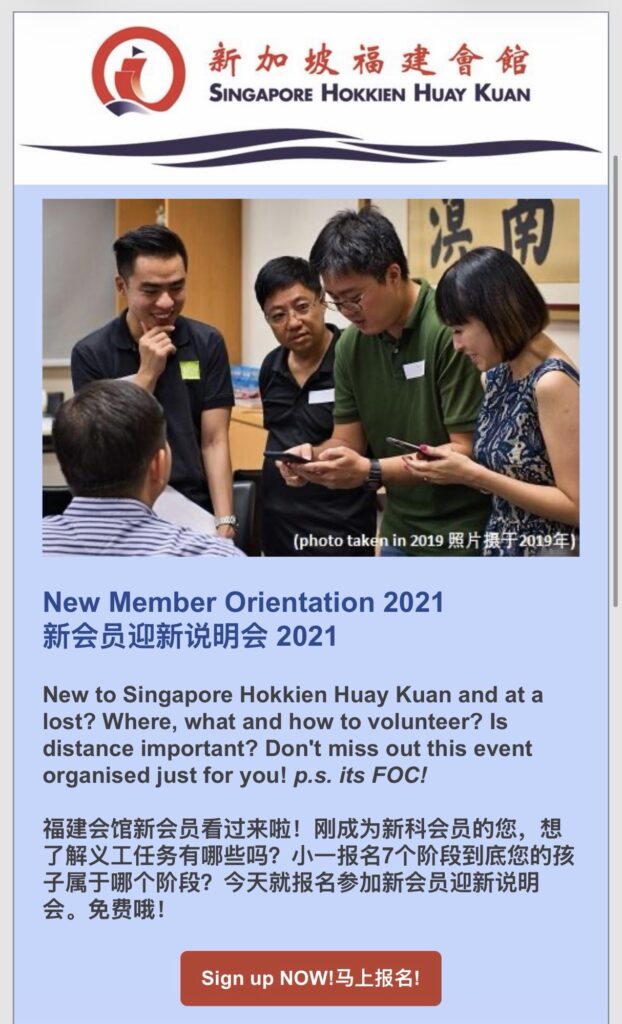
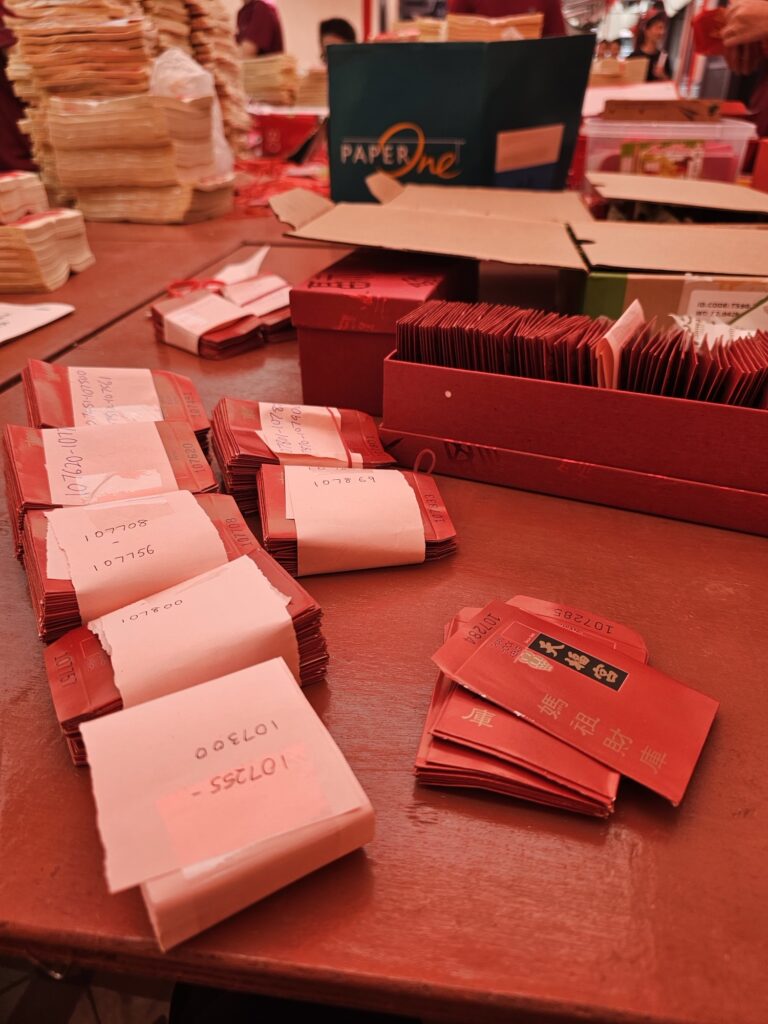
We went through Phase 2B via Singapore Hokkien Huay Kuan (SHHK).
And if you’re thinking of taking a Phase 2B route, my biggest advice is:
Research it much earlier than you think you need to.
This isn’t something you generally decide six months before registration and immediately qualify for.
For children born in 2021 and after, SHHK currently requires at least 1 year and 9 consecutive months of membership by 30 June of the registration year, as well as 80 hours of volunteer service completed by 31 May.
And simply becoming a member does not automatically mean you’re enrolled in its volunteer scheme — SHHK says members need to sign up separately for volunteering. Volunteering opportunities will be sent via email and you will be informed if shortlisted.
👉 SHHK Phase 2B Eligibility Checker:
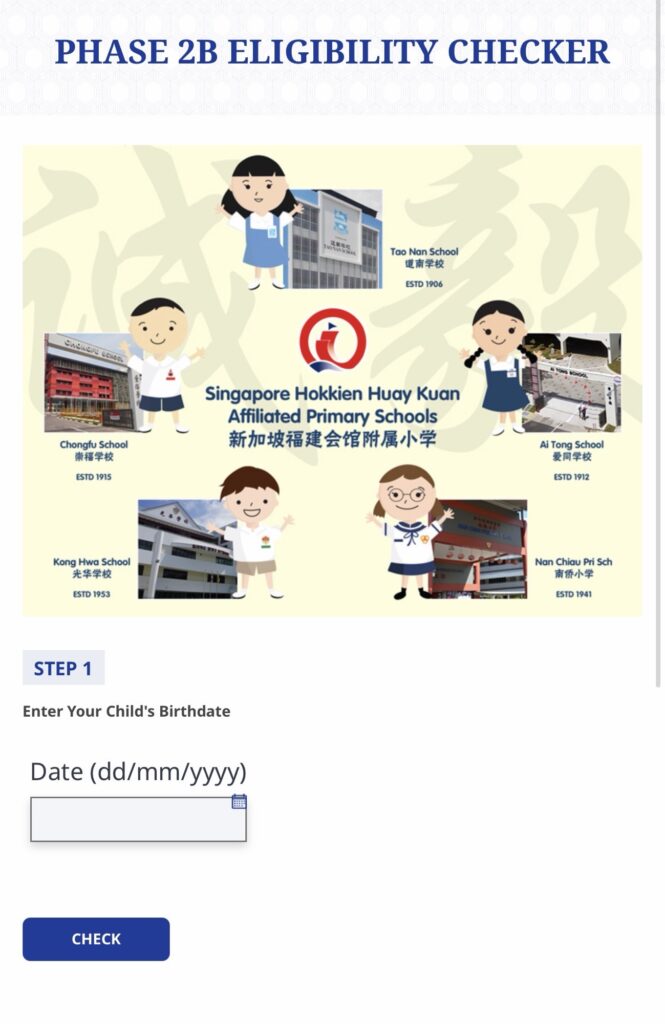
There are also eligibility requirements for SHHK ordinary membership, including Singapore citizenship and ancestry traceable to Fujian Province.
What if you’re not Hokkien?
Phase 2B isn’t limited to clan associations.
MOE’s other Phase 2B pathways include eligible parent volunteers and parents endorsed as active community leaders.
One important clarification though:
Simply volunteering in grassroots activities doesn’t automatically mean you qualify for Phase 2B.
The relevant category requires the parent to be endorsed as an active community leader.
So if you’re exploring this route, find out the requirements early rather than assuming that volunteering alone guarantees eligibility.
And even after qualifying for Phase 2B, admission still isn’t guaranteed.
If there are more eligible applicants than vacancies, balloting may still be required. SHHK itself states that its recommended applicants, parent volunteers and community leaders have equal chances in a ballot.
Check the Balloting History BEFORE You Decide on a School
One of the most useful things you can do before registering is look at previous years’ P1 registration data.
Don’t just ask:
“Did this school ballot last year?”
Ask:
“Which phase balloted — and which distance category was affected?”
That tells you much more about your actual chances.
MOE’s P1 registration portal specifically recommends looking at past vacancies and balloting data when considering schools.
👉 Past P1 vacancies and balloting:
👉 Current P1 vacancies and balloting updates:
And after actually living through P1, I would give distance from home much more weight than I did before.
A school may look fantastic on paper.
But when you’re doing that morning routine five days a week, saving 20–30 minutes of travel each way becomes very attractive. 😂
2. You Got the School — What Happens Next?
Once the registration stress is over, resist the urge to immediately buy the whole of Popular bookstore. 😂
Your school will subsequently send instructions about things such as:
- Administrative matters (received in September – school differs)
- Download Parents Gateway
- School Based Student care: There will be a separate uniform for student care.
- School Bus Service Provider: we contacted the number provided by the school and were quoted
- Purchase of School Uniform: We entered the school on weekdays to buy his uniform. On PE days he will wear PE attire. There’s no wipe down like in preschool.
- Purchase of School Book : We ordered via the link given and picked up from the school. You can also have to sent to your house for a cost
- No information on class allocation at this point
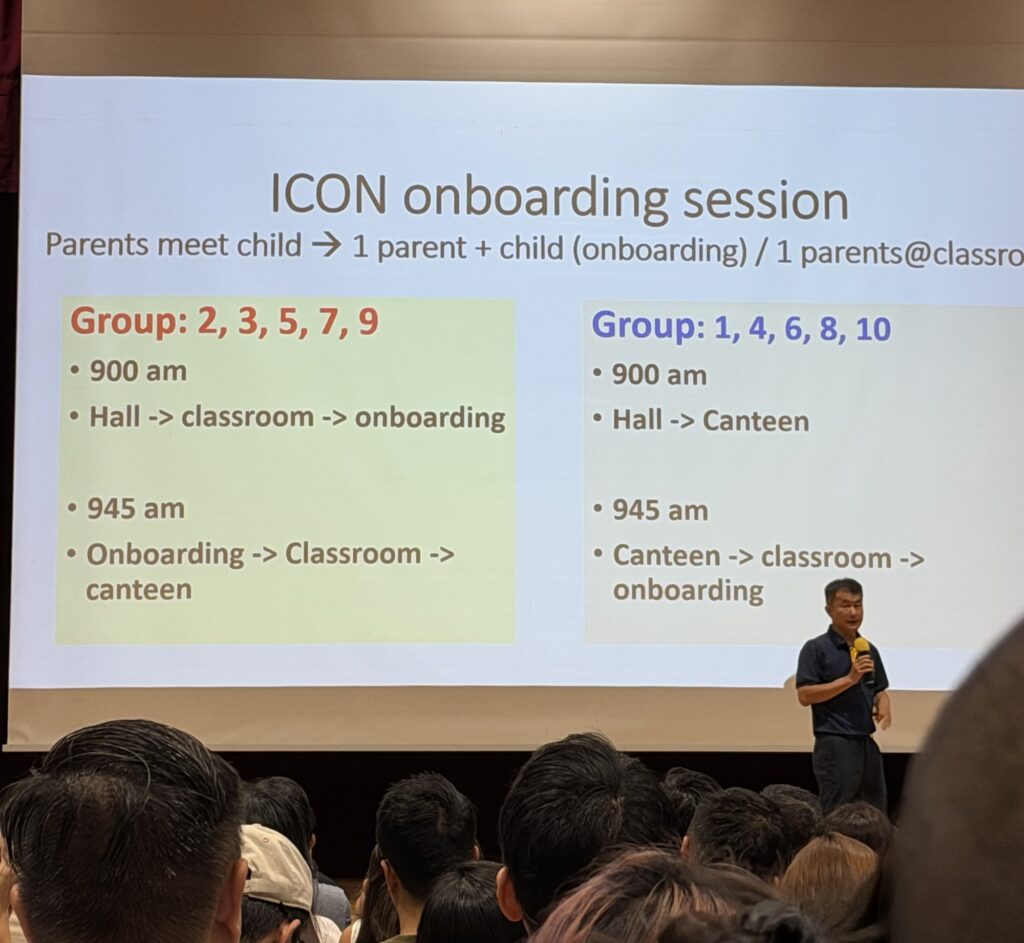
- P1 orientation (received in September – school differs)
- School will share information like school cultures, leadership, arrival/departure, school rules to help parents support your child in transiting to Primary 1.
- Children were given a temporary group and they are then guided to their temporary classes for some activities without parents
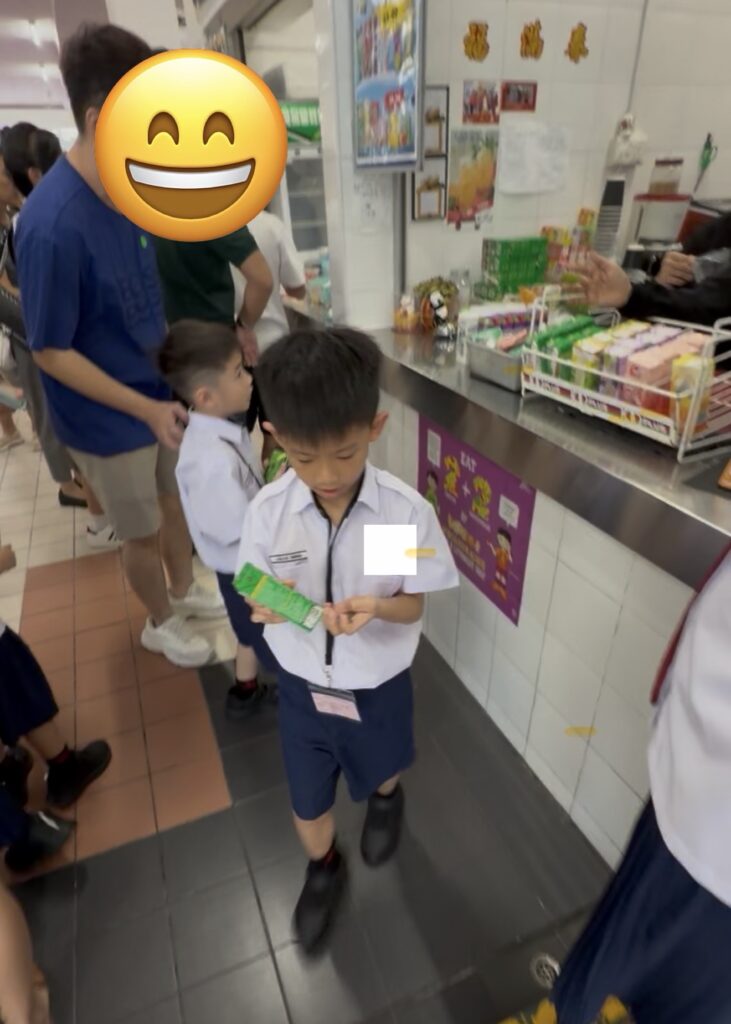
- Some canteen stores are open. For our school, there’s a scheduled break and we encouraged our boy to purchase from the stalls
- We also created the boy first school email address and was introduced to SLS
- First day of school arrangements (via Parents Gateway)
My advice is:
Wait for your school’s actual instructions before buying everything.
Different schools have different booklists, stationery requirements and arrangements.
This is also the time to start asking about practical things that affect your family’s everyday routine.
For example:
Is there a school-based student care centre?
How do I apply?
Is there a school bus?
What time does school end?
What happens during the first week?
Does the school have a P1 buddy system?
The Buddy/Mentor System Helped More Than I Expected
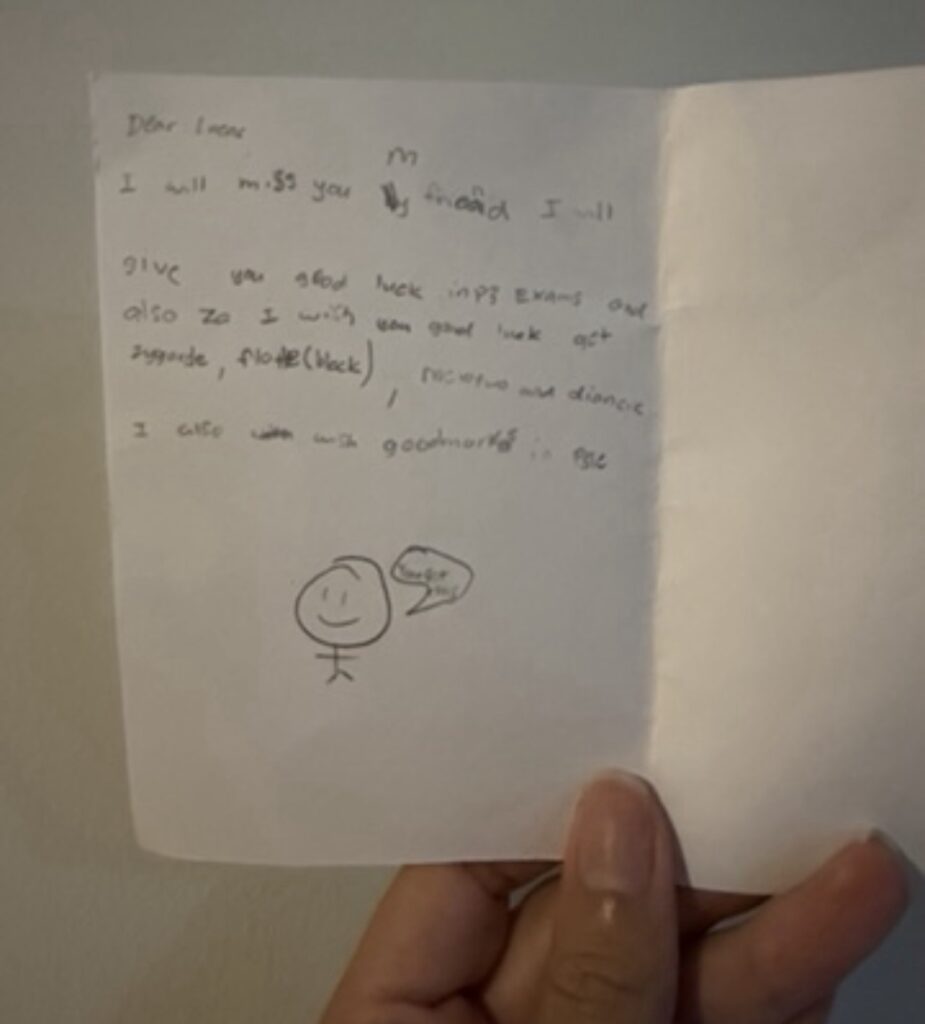
My son had an older student mentor/buddy tagged to him at the beginning.
I really appreciated this.
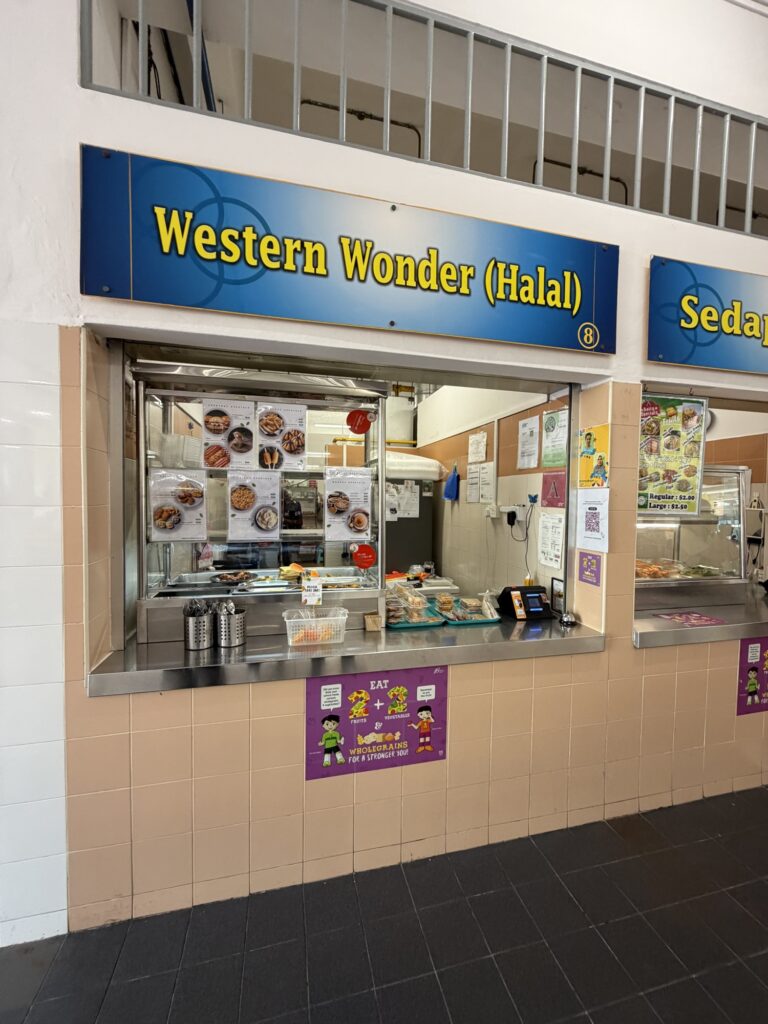
Imagine entering this huge school at six or seven years old.
Where is the toilet?
Where is the canteen?
How do I buy food?
Where do I return my plate?
Where am I supposed to go after recess?
These things seem completely obvious to adults.
They’re not necessarily obvious to a child entering P1.
Different schools handle P1 transition differently, so this is something I’d ask during orientation:
“Does the school have a buddy or mentor programme for P1 students?”
3. Recess, Lunch & Pocket Money: The Part I Worried About Most
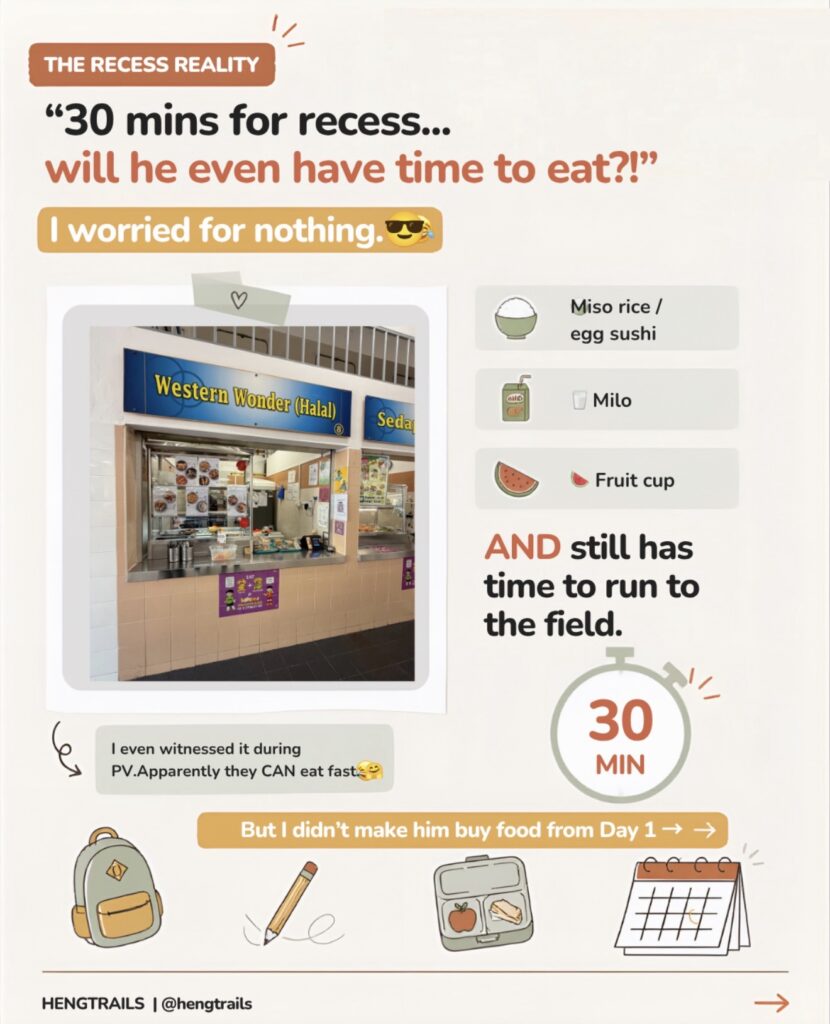
Of all the things I worried about before P1, recess was surprisingly high on my list.
“Only 30 minutes?!”
They need to walk to the canteen.
Queue.
Decide what they want.
Order.
Pay.
Find a seat.
Eat.
Clear everything.
Surely he isn’t going to have enough time?
Turns out…
Mummy worried way too much. 😂
My son somehow manages to buy miso rice or egg sushi, go to the drinks stall for Milo, then get a fruit cup…
…and still has time to go to the field and run around with his friends.
All within 30 minutes.
I Did Parent Volunteer Duty During Recess
I had the opportunity to do Parent Volunteer duty at a booth during their canteen hours.
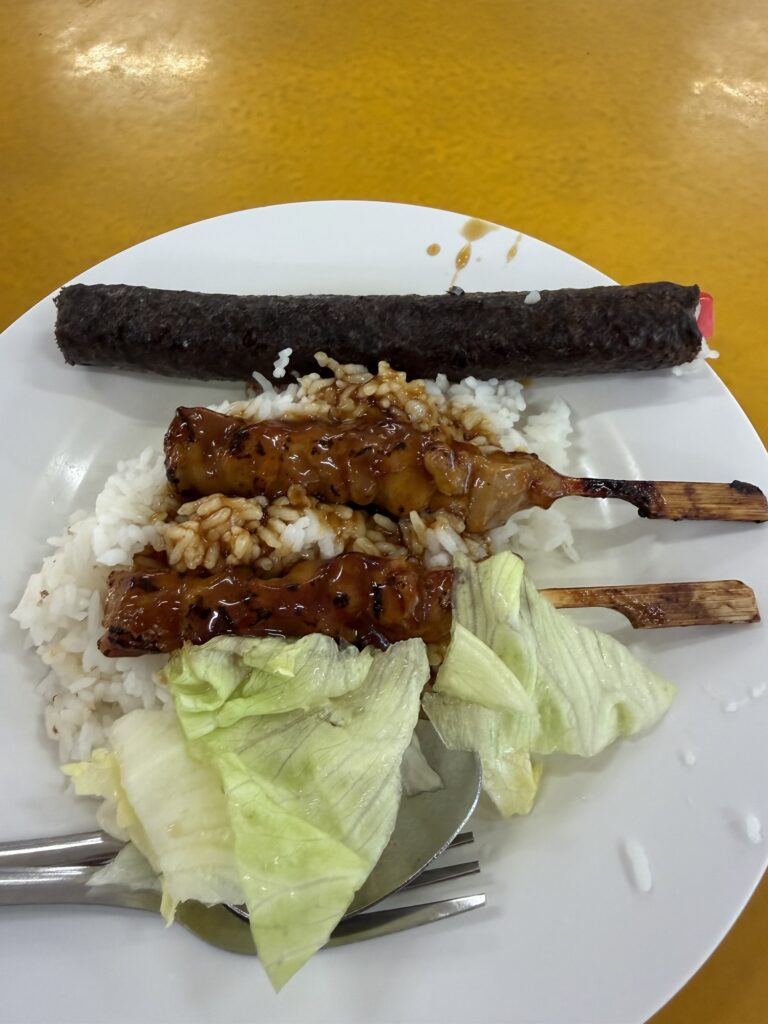
And suddenly I got a glimpse into this whole part of his life that I normally never see.
I watched him navigate the canteen.
Buy his food.
Eat.
Talk to his friends.
And then disappear off to play.
My first thought?
WOW. You CAN eat quickly.
Apparently this skill only appears when Mummy isn’t sitting next to you. 😂
But aside from that, I found it genuinely reassuring.
We spend months worrying about whether they’ll cope.
Then you stand there quietly watching and realise:
They’re managing.
If your child’s school opens Parent Volunteer opportunities and your schedule allows it, I’d recommend trying it at least once.
It’s also much more informative than asking:
“What did you do during recess?”
and getting:
“Nothing.”
😂
I Packed BOTH Recess and Snack During His First Month
I didn’t send my son into school on Day 1 expecting him to confidently queue at the canteen.
For roughly the first month, I packed food for both recess and snack break every day.
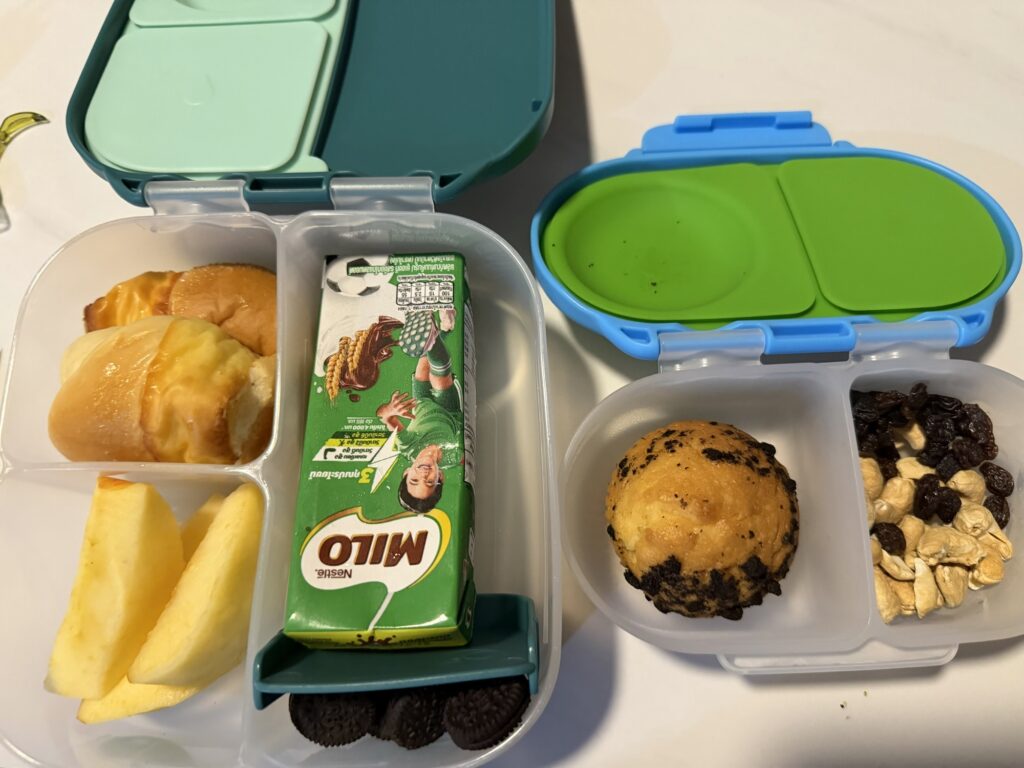
Was it more work?
Definitely.
But my thinking was that he already had enough changes to deal with.
New school.
New teachers.
New classmates.
New timetable.
New routines.
Buying food independently didn’t need to become another thing he had to master immediately.
Then one day, he told me himself that he felt comfortable buying food.
That was my cue.
He was ready.
And looking back, I really liked this gradual approach.
If your child isn’t ready to buy food during Week 1, don’t panic.
There’s no prize for being the first P1 child to independently buy chicken rice.
Give them time.
Cash First, Cashless Later

At the beginning, I deliberately gave him real cash.
Even though cashless payment is obviously easier, I wanted him to first understand:
How much is $1?
What does 50 cents look like?
If something costs $1.50 and I give $2, how much should I get back?
How much money do I have left?
Those are basic life skills I still want him to have.
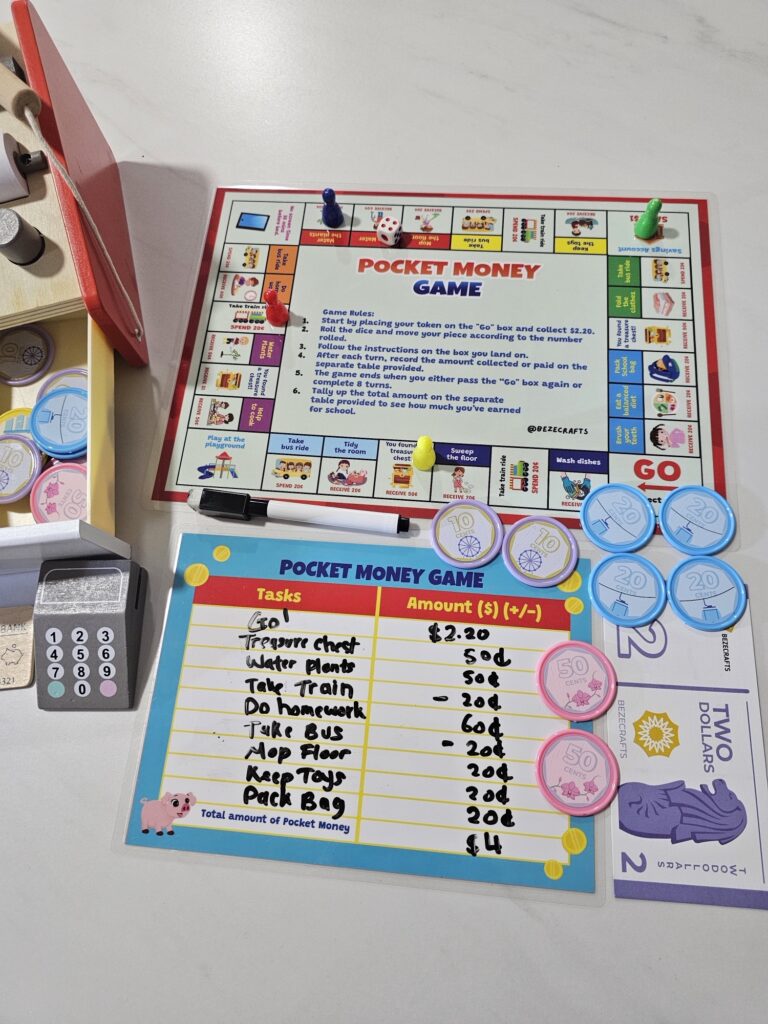
This is also one of the reasons we created our Bezecrafts Money Smart School Kit.
👉 [Bezecrafts Money Smart School Kit]
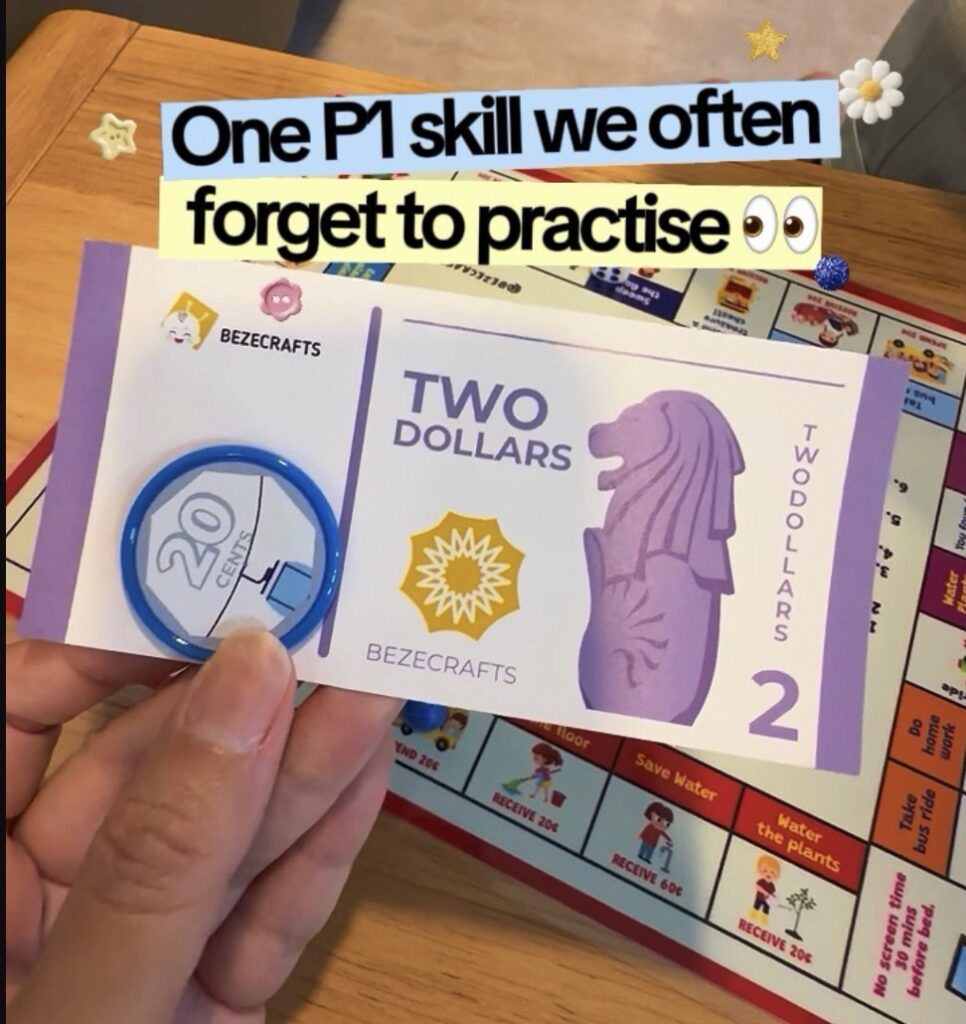
It lets children role-play common school scenarios using Singapore money, such as buying food from the canteen or stationery from the bookshop.
Instead of doing another random subtraction worksheet:
“You have $3. Your noodles cost $1.50 and fruit costs $0.50. How much is left?”
Suddenly the maths has a purpose.
Practise a “Canteen” at Home
This is one of the easiest ways to prepare a child for P1.
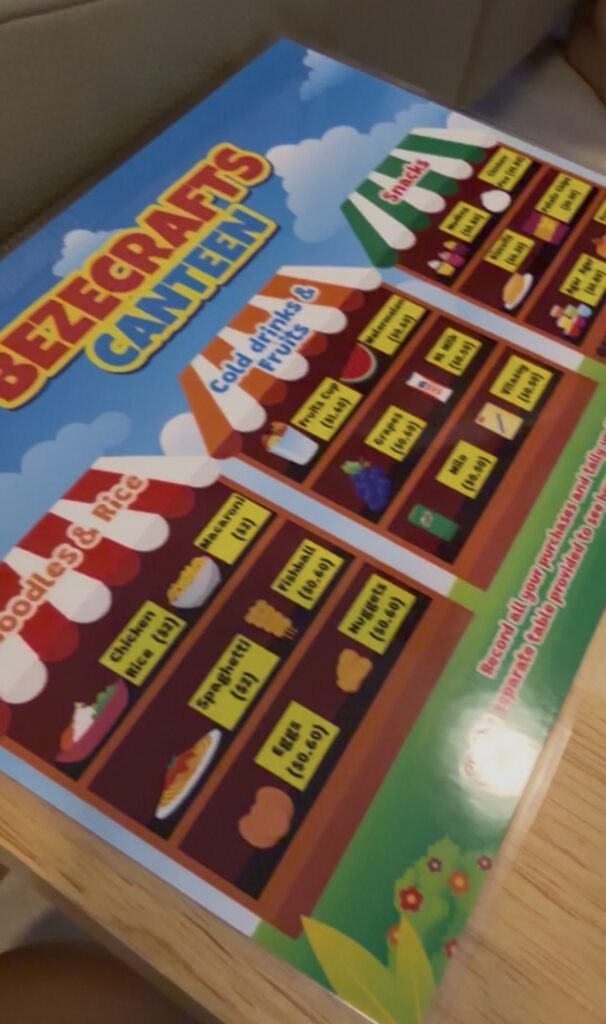
Put up pretend stalls:
Chicken Rice — $1.50
Fruit Cup — $0.50
Milo — $0.80
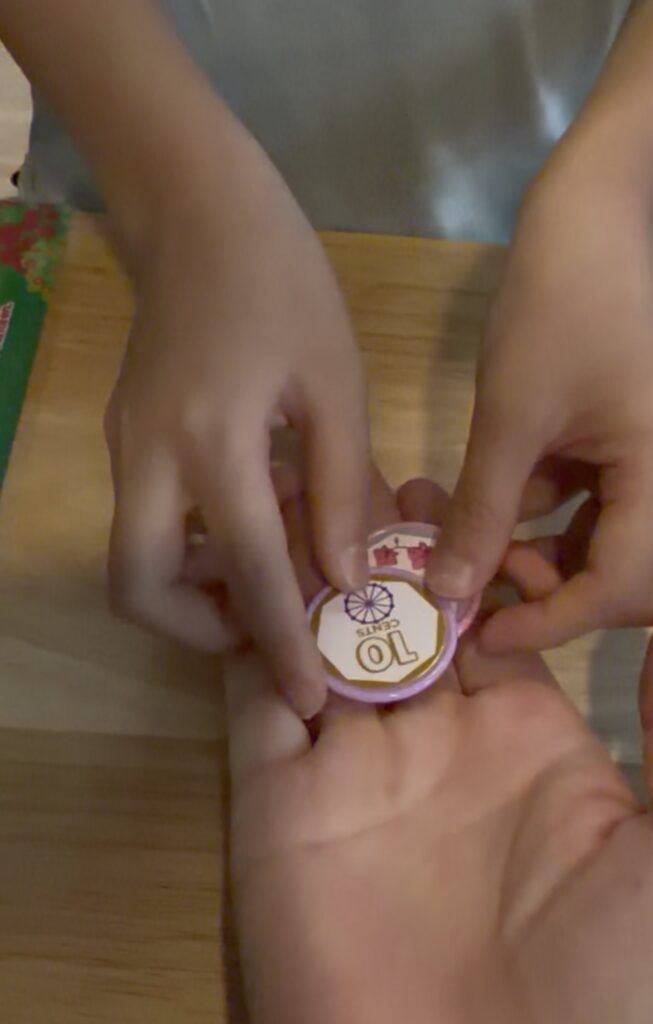
Give them some coins.
Let them choose.
Order.
Calculate.
Pay.
Check their change.
Carry their food.
Then clear their tray.
You can also occasionally let them order and pay by themselves at a hawker centre while you’re standing nearby.
You’re still there if they need help, but they learn how to speak up confidently.
Lunch Boxes, Snack Boxes & Water Bottles: Test Them BEFORE School
One very practical tip:
Make sure your child can actually open everything you’re giving them.
It sounds obvious.
Until somebody comes home with an untouched snack because:
“I couldn’t open it.”
😂
Before school starts, let your child practise opening and closing:
- lunch box
- snack container
- water bottle
- food packaging
- wallet
For P1, my priorities are:
easy to open + leakproof + lightweight.
For wallet, get one that comes with a lanyard or a hook that your child can attach it to their pants/skirt.
Pretty comes after that.
And label everything.
Water bottle.
Lunch box.
Wallet.
Pencil case.
School bag.
If it is physically capable of disappearing, put your child’s name on it. 😂
The P1 Preparation I Would Prioritise Over More Worksheets
Problem: Suddenly Mum and Dad aren’t there to help
Preschool children are used to having adults nearby.
In Primary 1, there are many moments where they’re expected to manage themselves.
Academics matter.
But after watching my son transition, I think parents sometimes underestimate how much of P1 is about independence and confidence.
Your child suddenly needs to remember:
Bring your belongings.
Find the toilet.
Follow instructions.
Pack up.
Tell someone when something is wrong.
Ask a teacher for help.
Manage a disagreement with another child.
That is a lot.
So alongside reading and maths, these are the things I’d practise.
Everyday Independence
Let them:
- go to the toilet independently
- dress themselves
- open food containers
- refill/open their water bottle
- carry their own tray
- clear their own plate
- pack their school bag with you
- recognise their own belongings
- remember their class
The toilet is something I wouldn’t overlook
This sounds incredibly basic until something happens.
One of his classmates couldn’t unzip his fly in time and unfortunately ended up wetting his pants.
That really made me realise that toilet independence should actually be part of P1 preparation.
Don’t just ask, “Can you go toilet yourself?”
Let your child practise while wearing the actual school uniform.
Speaking Up
This is a big one for me now.
Teach them that if:
- they’re hurt
- someone is repeatedly bothering them
- they’ve lost something
- they’re confused
- they feel unsafe
they should tell an adult.
Not every incident between children is bullying.
Kids accidentally hurt each other.
Arguments happen.
But I want my child to understand that he never needs to stay silent because he’s afraid of getting someone into trouble.
👉 SHOP OUR P1 INDEPENDENCE ESSENTIALS
Working Parents: Prepare for More No-School Days Than You Expect
This is probably the section I wish someone had shown me before P1.
Before primary school, I mentally calculated childcare around:
School holidays.
Public holidays.
Done.
Nope. 😂
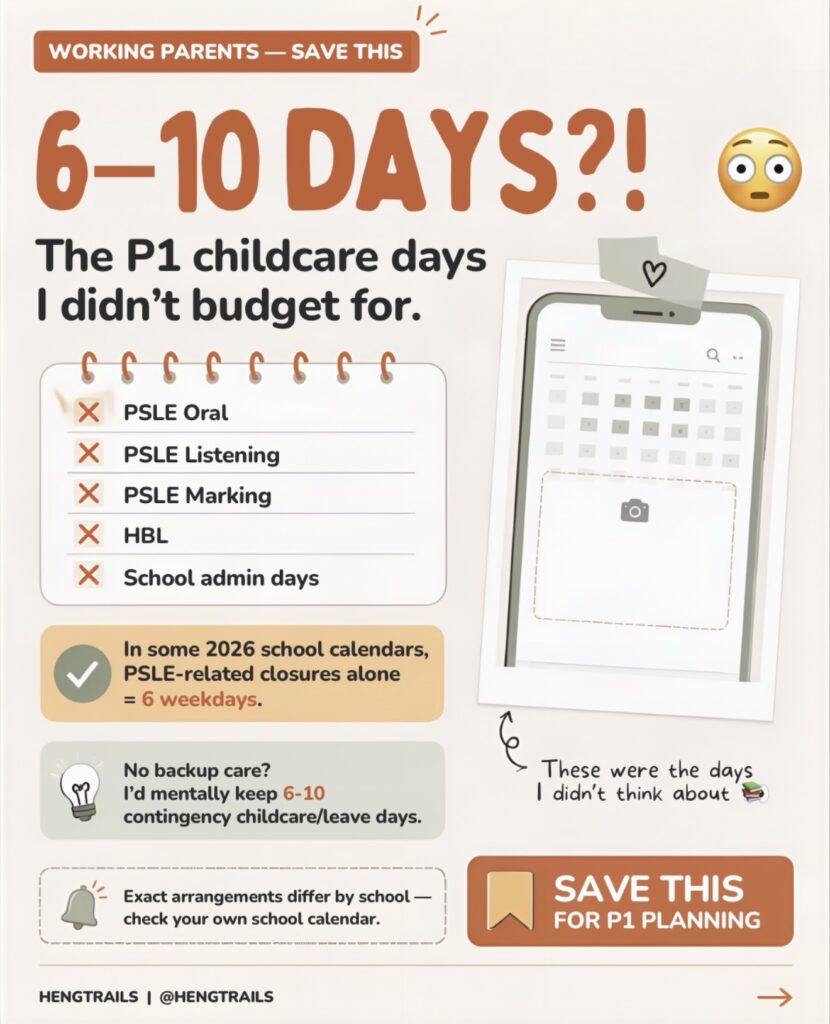
Primary schools can also have weekdays where P1 children don’t report normally because of national examinations, marking exercises, HBL or school-specific administrative arrangements.
And if you don’t have grandparents, a helper, flexible working arrangements or student care?
Those become childcare days you need to solve.
How Many Extra Leave Days Should You Mentally Prepare For?
There isn’t one fixed number for every school.
But if I had zero alternative childcare, I would personally keep roughly:
6–10 working days of contingency childcare/annual leave
available on top of the official school holidays.
Why?
For 2026 school calendars.
12–13 August for PSLE Oral
15 September for PSLE Listening Comprehension
12–14 October as PSLE Marking Days
3 November as Results Processing Day !???
That brings those national-exam-related closures alone to seven weekdays for P1 children.
And some schools have even more school-specific arrangements. They’re also separate HBL days which amounts up to around ten weekdays for p1 children.
This does NOT mean every school will have exactly the same number.
That’s the important part.
Your own school decides some of its arrangements.
So once the school calendar comes out, I would immediately sit down and highlight every:
NO SCHOOL
HBL
PSLE
ADMIN DAY
EARLY DISMISSAL
Then decide who’s covering it.
Mummy.
Daddy.
Grandparents.
Student care.
WFH.
Whatever your arrangement is.
Don’t discover on Sunday night that your child doesn’t have to report the next morning. 😂
If school ends earlier at 1045am for certain occasions (eg Teacher’s Day celebrations, children days celebration) but your external student care only starts at 1.30pm, you will have to find a caregiver for the gap hours..
Student Care: What Our Experience Taught Me
Student care honestly deserves its own article.
We’ve experienced both a premium private student-care programme costing approximately $1,500 a month and later our school’s student care at around $200+.
And my biggest takeaway was very simple:
Expensive doesn’t automatically mean better.
Our private centre offered more on paper, but we experienced incidents that made us uncomfortable, particularly around injury management and communication.
The last straw was an incident where another child scratched my son’s arm with a pencil and left a long visible mark. We didn’t feel comfortable with how the situation was subsequently handled and communicated, so we withdrew him.
Later, we managed to get a place in his school-based student care.
The irony?
My son said it felt basically the same.
And from a parent’s perspective, I actually found the communication better.
There was also no need for transport between school and another centre.
For roughly $200+?
For us, it made much more sense.
MOE says every primary school has a school-based Student Care Centre, although places can still be limited.
So if you think you may need student care:
Apply early.
And instead of only asking what enrichment programmes they offer, I’d now ask:
- How are injuries handled?
- When will parents be informed?
- How are conflicts between children managed?
- Who supervises my child?
- Does the centre operate on certain no-school days?
- How does the centre communicate concerns?
- Is there somewhere for an exhausted P1 child to rest?
We eventually withdrew my son from school-based student care too — not because it was bad, but because he kept telling us he was tired.
When Grandpa became available to look after him, we chose to let him go home instead.
And at home?
He could nap.
That has made me think much more about whether student care is right for every child — rather than simply whether a centre is “good”.
I’ve written about our whole experience separately because there is far too much to squeeze into this P1 guide.
👉 READ NEXT: We Paid $1,500 for Private Student Care, Then Switched to a $200+ School-Based One — What We Learnt
DIGITAL READINESS: IPAD SKILLS DON’T ALWAYS TRANSFER TO A LAPTOP
Problem: This one caught us by surprise
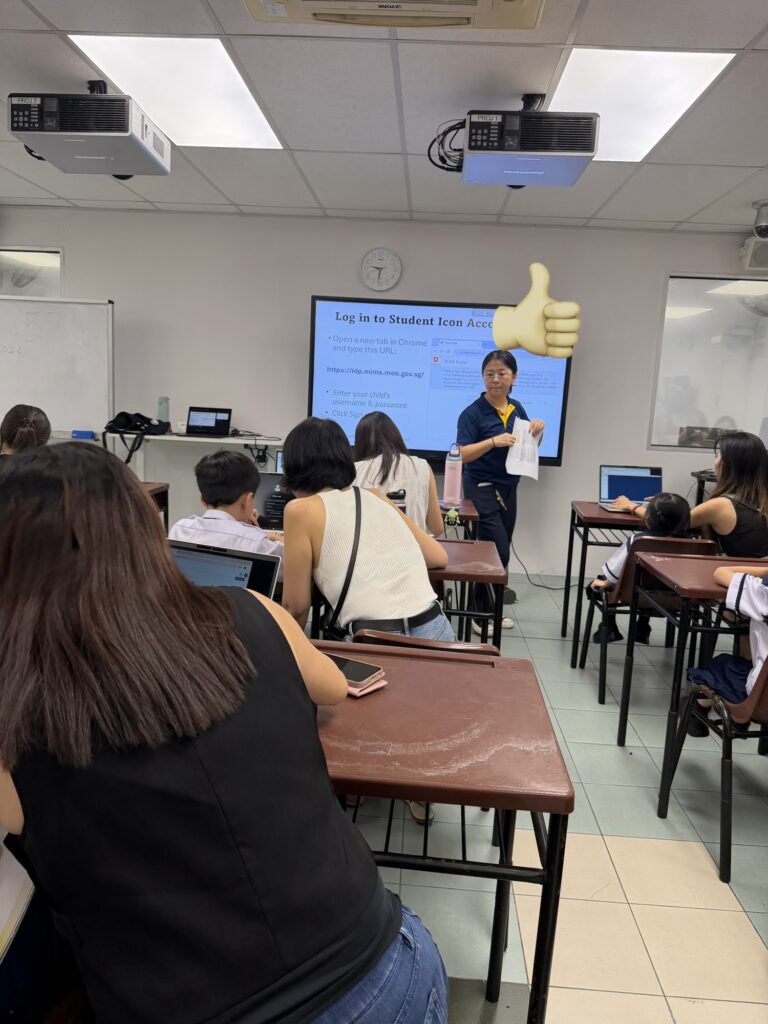
During school orientation, we had to create an email account.
That’s when I realised that while children today can swipe around a tablet without anyone teaching them, using an actual keyboard and mouse/trackpad can be completely different.
Finding letters on the keyboard was slower than I expected.
And once P1 starts, they’ll eventually encounter e-learning through platforms such as SLS.
Solution: Give them some laptop time before P1
Practise:
- Using a mouse/trackpad
- Finding letters and numbers
- Typing their name
- Space bar
- Backspace
- Enter
- Capital letters
- Basic username/password concepts
- Opening and closing tabs
They don’t need formal computer lessons.
Just don’t let the first time they seriously use a physical keyboard be when they’re trying to complete an assignment.
THE STUDENT HANDBOOK WILL BECOME YOUR SECOND BRAIN 😂
Problem: There is suddenly a LOT to remember
Homework.
Things to bring.
English spelling.
Chinese spelling.
Forms.
School activities.
Solution: Build a checking routine
Get your child used to checking their handbook — but especially at the beginning, parents should check too.
My favourite simple hack
📸 Photograph the English and Chinese spelling lists and save them on your phone.
Because the spelling list sitting peacefully inside the school bag isn’t going to remind me that spelling is tomorrow. 😂
You can also create a dedicated P1 album/folder on your phone for:
- Spelling lists
- Timetable
- School calendar
- Important notices
- Reference information
Much easier than searching through 12,000 photos later.
PARENTS NEED TO BE P1-READY TOO
Problem: School communication suddenly comes from everywhere
Before school starts, familiarise yourself with:
Parents Gateway — school notices, consent forms and information.
Your school’s communication platform — our school uses ClassDojo; your child’s school may use something different.
SLS — understand what it is before the first e-learning day.
Student handbook — check regularly.
School calendar — save important dates immediately.
Create a simple system so you don’t have information scattered across apps, screenshots, WhatsApp chats and pieces of paper.
My P1 Preparation Checklist
If I were starting the whole P1 journey again, this is what I’d have ready.
Registration & School
☐ Understand your eligible registration phase
☐ Check previous balloting records
☐ Check your distance from shortlisted schools
☐ Research Phase 2B early if relevant
☐ Attend P1 orientation
☐ Apply for student care early if needed
☐ Check school bus arrangements
Recess & Money
☐ Recognise Singapore notes and coins
☐ Understand simple prices
☐ Practise ordering food
☐ Pay and check change
☐ Carry and clear a tray
☐ Open lunch/snack boxes independently
☐ Decide whether you’ll use cash or cashless
👉 Practise school canteen money skills
School Essentials
☐ Lightweight school bag
☐ Easy-open water bottle
☐ Easy-open lunch/snack box
☐ Wallet or coin pouch
☐ Pencil case
☐ Comfortable school shoes
☐ Name labels
Independence
☐ Toilet independently
☐ Pack belongings
☐ Remember own class
☐ Ask an adult for help
☐ Tell an adult when hurt
☐ Speak up if something feels wrong
Digital
☐ Keyboard
☐ Mouse/trackpad
☐ Basic login
☐ Typing name
☐ Familiar with computer-based learning
PARENTS
☐ Parents Gateway
☐ School communication platform
☐ SLS awareness
☐ Photograph spelling lists
☐ Save school calendar
☐ Plan HBL/closure childcare
☐ After-school arrangement
☐ Backup care
What I Wish Someone Had Told Me Before P1
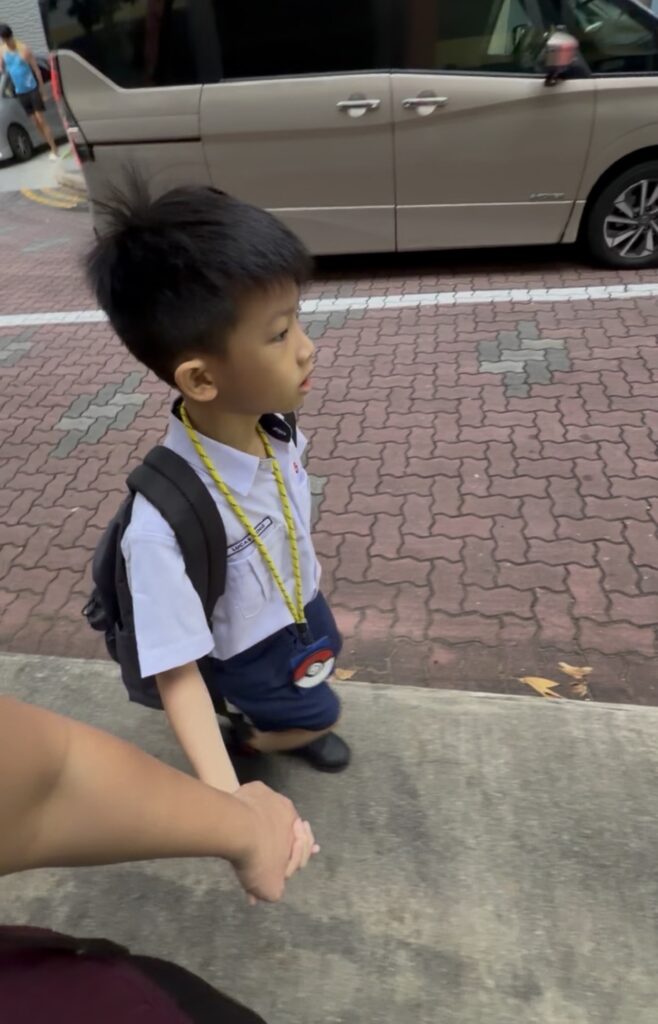
Before my son entered Primary 1, I spent so much time thinking about:
Which school will he get into?
Now that we’ve actually experienced P1, I realise that’s only one part of the transition.
The everyday things matter just as much.
Can he independently buy lunch?
Will he tell an adult if he gets hurt?
Is he getting enough rest?
Who looks after him when there’s suddenly no school?
Does he know how to manage money?
Can he keep track of his own belongings?
And then slowly, something quite lovely happens.
The child you were worried wouldn’t have enough time to eat during a 30-minute recess…
is suddenly buying miso rice, Milo AND fruit, finishing everything and somehow still squeezing in a run around the field.
The child whose lunch you packed every morning eventually tells you:
“Mummy, I can buy myself already.”
And I think that sums up the P1 transition for me.
You don’t need your six-year-old to arrive on Day 1 completely independent.
You just need to give them enough support and practice that, little by little, they start showing you:
“I can do it.”
And apparently they really can.
Even within 30 minutes. 😂
Useful Primary 1 Singapore Links to Bookmark
Past P1 Vacancies & Balloting Data
Current P1 Vacancies & Balloting
Singapore Hokkien Huay Kuan Phase 2B Checker
MORE OF OUR P1 RESOURCES
If you’re preparing for P1 too, I’ve put together more resources from our experience:
💰 Money readiness
→ Bezecrafts Money Smart Kit
Pocket Money Game + Canteen & Bookstore role-play
🎒 P1 shopping
→ What We Actually Bought & Used for P1
My school bag, coin pouch, pencil case, labels, water bottle and other recommendations.
🏫 Registration
→ Our Phase 2B / Hokkien Huay Kuan Volunteering Experience
📚Student Care
→ Our Student Care Experience
Save this guide if your child is entering Primary 1 soon — and I’ll continue updating it whenever we discover another one of those “why did nobody tell me this before P1?” moments. 😂 DM us on IG @hengtrails if you have any questions!!
This article reflects our family’s own Primary 1 experience together with publicly available information as at September 2026. P1 registration criteria, balloting data, school calendars, Phase 2B requirements and student-care arrangements can change, so always check the latest information directly with MOE, your child’s school and the relevant organisations.
Some links in this article may be affiliate links. If you purchase through them, I may earn a small commission at no additional cost to you. I only recommend products and resources that I genuinely think are useful for families.