Choosing a student care in Singapore sounded like one of the easier parts of preparing for Primary 1.
Find somewhere convenient, make sure someone can look after him after school, enrol him… settled, right?
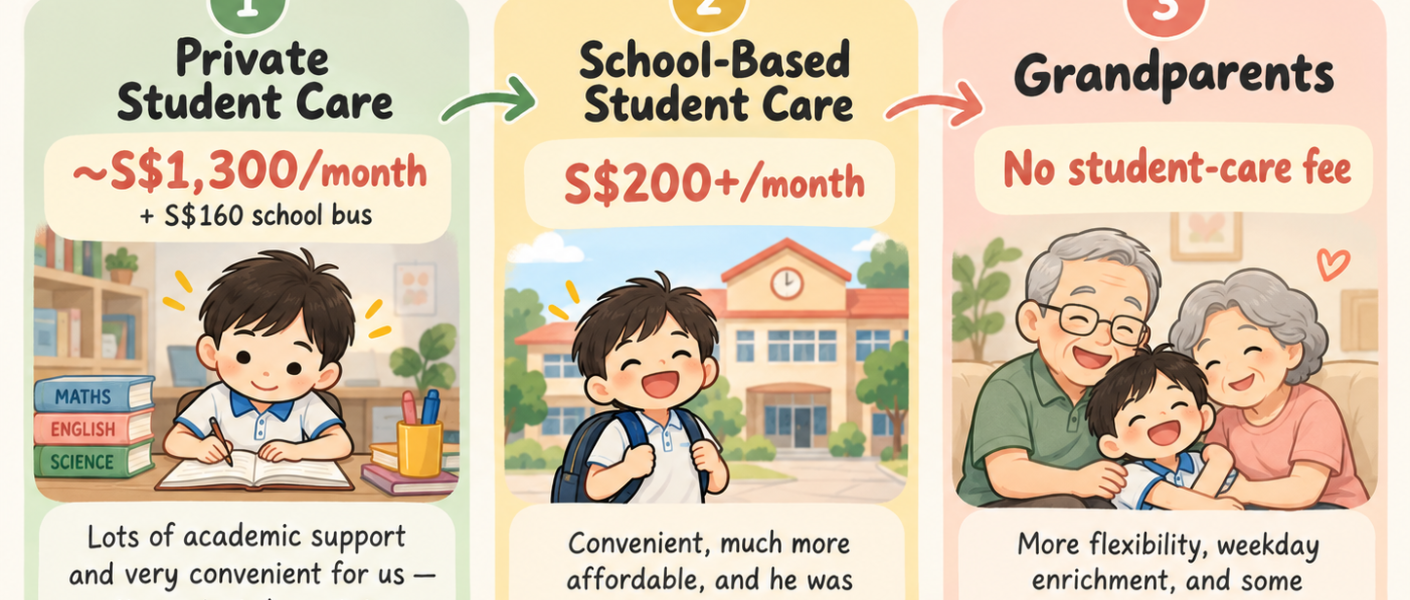
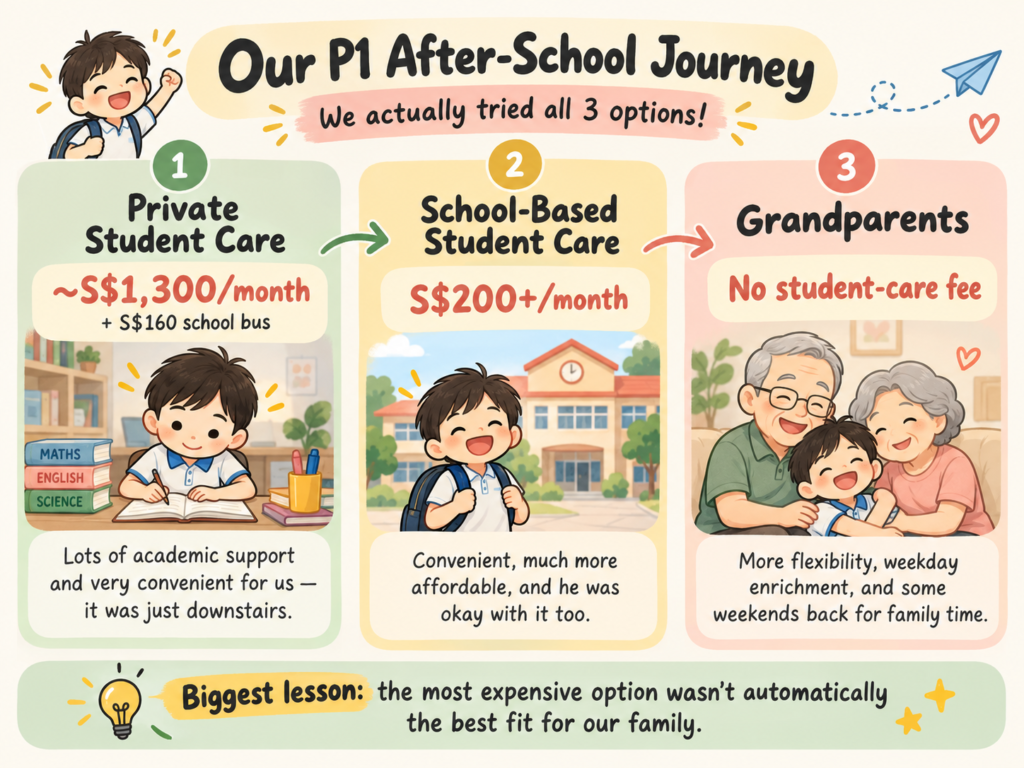
Well, our P1 student-care journey ended up looking like this:
~S$1300 private student care → S$200+ school-based student care → Grandpa. 😂
Yes, we actually tried all three.
And after experiencing them ourselves, I realised that choosing student care isn’t simply about finding the centre with the nicest facilities, most enrichment or highest fees.
There are things I would pay MUCH more attention to now — including communication, how incidents are handled, the child’s actual daily routine and whether you’re paying for services your family really needs.
So if your child is entering Primary 1 and you’re deciding between private student care, school-based student care or grandparents, here’s our honest experience and what I wish I’d known before P1.
A quick disclaimer: This is our family’s personal experience. Every student care centre, school and child is different. What we experienced at our private and school-based centres should not be taken as representative of all student cares.
What Is Student Care in Singapore?
Student Care Centres, or SCCs, provide care and supervision for school-going children outside school hours.
MSF states that SCCs provide meals and homework supervision, while individual centres may also offer academic support, character-development programmes, enrichment and recreational activities.
And that’s important because student care can look very different from one centre to another.
“Homework supervision” can mean different levels of help.
One centre may include English and Maths enrichment.
Another may focus more on care, play and activities.
So before comparing student-care centres, I think parents need to decide:
What do I actually need student care to do for my family?
Private vs School-Based Student Care vs Grandparents: Our Experience

These were our arrangements, so don’t use the table as a blanket comparison of every private and school-based SCC.
Now for what actually happened.
1. Why We Started With Private Student Care
Before P1 started, a private student care seemed like the most complete option for two working parents.
Our centre cost around S$1,300 per month, plus another S$160 monthly for the school bus from school.
That’s definitely a premium.
But there was another huge reason we chose it:
It was literally downstairs from our home.
Honestly, the location couldn’t have been more convenient.
After work, we could simply head downstairs to pick him up.
And the programme itself sounded pretty ideal.
At our private student care, we had things like:
- Better-curated lunches
- Closely supervised homework
- Spelling revision
- 听写 revision
- English enrichment
- Maths enrichment
- Structured activities
For working parents, the appeal is obvious.
You pick your child up after work knowing that a good part of the schoolwork has already been handled.
Less rushing home to discover:
“Mummy… tomorrow got 听写.” 😅
And less of your evening spent going through unfinished homework.
So yes — there were genuinely good things about our private student care.
Which was why deciding to withdraw him wasn’t an easy decision.
Why We Eventually Withdrew From Our Private Student Care
It wasn’t because I believed the centre itself was unsafe.
And it wasn’t because I expected children to never get hurt.
Kids are kids.
Falls happen.
Arguments happen.
Children accidentally hurt one another.
My concern was something different:
How are incidents handled — and how are parents informed?
We had several situations that gradually made us uncomfortable with the way communication and follow-up were handled.
I’ll share two that particularly changed my perspective.
Incident 1: He Came Home With a Wound on His Back
One day, our son came home with a wound on his back.

He told us that while changing in the toilet, he had knocked his back and hurt himself.
According to him, one teacher asked him to look for another teacher to get the wound attended to.
But somewhere along the way, it didn’t happen.
Maybe he couldn’t find the teacher.
Maybe he simply forgot.
But…
Come on. He was in Primary 1.
When I only discovered the wound after he reached home, it made me stop and think:
Should a seven-year-old really be responsible for ensuring his own injury gets followed up?
That was the first time I started thinking about student care differently.
Before this, I had asked about homework.
Enrichment.
Meals.
Transport.
I had never thought to ask:
“What exactly happens if my child gets injured?”
Who checks him?
Who provides first aid?
Who makes sure it actually happens?
When will parents be informed?
Suddenly those questions felt far more important than whether Maths enrichment was included.
Incident 2: The Pencil Scratch
Another time, he came home with a long scratch caused by another child’s pencil.
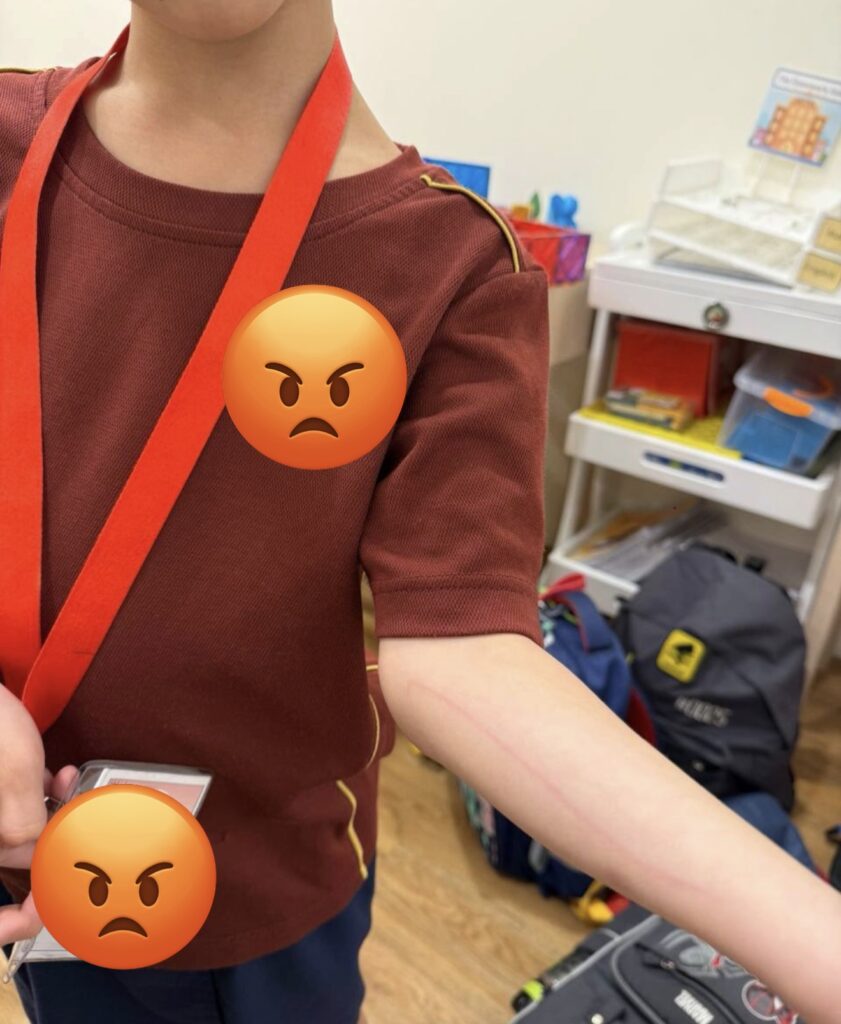
And again, the fact that an incident happened wasn’t my main issue.
Seven-year-olds are seven-year-olds.
What frustrated me was how the situation was communicated.
I initially received an SMS telling me that it had been an “accident”.
Looking at the scratch, naturally I had questions.
So I went down to the centre wanting to understand exactly what had happened.
That was when I learnt that the teacher communicating with me had not personally witnessed the incident and had based the initial explanation on what the children had said.
And that was what bothered me.
If nobody had yet established exactly what happened, I would personally much rather receive:
“There was an incident between the children. We’re checking what happened and will update you.”
rather than being given a conclusion immediately.
I requested that the incident be investigated properly, including reviewing the available CCTV.
The matter eventually reached management, but getting the full follow-up took much longer than I was comfortable with.
Maybe I had been spoilt by our preschool experience, where we were accustomed to relatively quick updates whenever something happened.
But it made me realise something about myself as a parent:
Timely and transparent communication is something I cannot compromise on.
That became the last straw for us.
We withdrew him and requested our deposit back.
Were We Saying the Private Student Care Was Bad?
No.
And I think this distinction is important.
There were many things about the centre that we genuinely liked.
It was ridiculously convenient for us.
The programme was structured.
The meals were good.
The homework support was helpful.
English and Maths enrichment were included.
Our concern was specifically about how certain incidents and parent communication were handled.
And because we were paying a fairly substantial premium every month, we also expected a certain level of confidence and reassurance in the overall experience.
Eventually, we didn’t feel the premium was justified for our family.
Another child and another family may have a completely different experience.
This isn’t meant to suggest that all private student cares operate the same way.
The Biggest Thing Private Student Care Taught Me
Before P1, I compared centres using things that were easy to compare:
Price. Meals. Homework. Enrichment. Facilities. Location.
If I were doing it again, I’d add something much higher up my list:
How does the student care handle incidents?
When visiting a student care centre, I would now ask:
- When will parents be informed if a child gets injured?
- Who administers first aid?
- Who follows up afterwards?
- What happens if no teacher witnessed the incident?
- How does the centre establish what happened before communicating with parents?
- Is CCTV available and what is the review process?
- Who handles escalations?
- How quickly should parents expect an update?
- How are conflicts between children handled?
These questions aren’t as exciting as looking at enrichment programmes.
But now?
I’d ask them before I ask about Maths.
2. Then We Tried School-Based Student Care
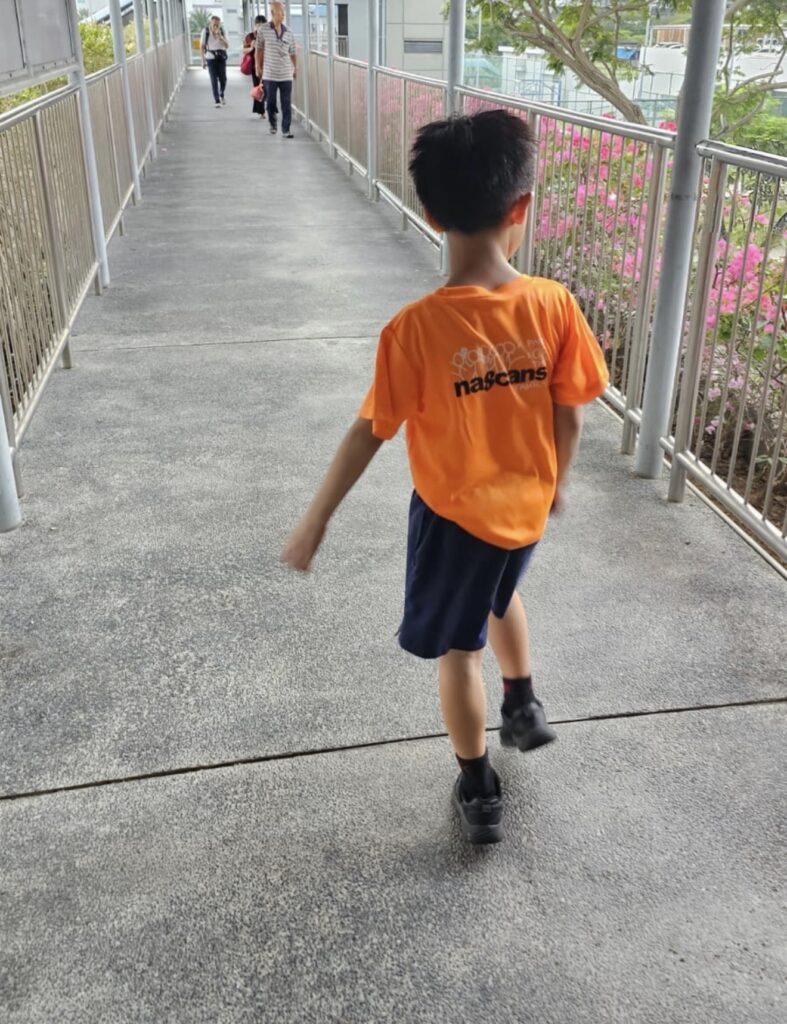
After withdrawing from private student care, we moved him to his school-based student care.
And this was probably the biggest surprise for me.
I asked him how it was.
His verdict?
Okay lor. 😂
No dramatic complaints.
No refusing to go.
He was perfectly fine.
And financially, there was a HUGE difference.
We went from around:
**S$1,300+ monthly fees
- S$160 school bus**
to roughly:
S$200+ per month.
For us, that was close to S$1,000+ saved every month, plus the transport cost.
Suddenly I started questioning how much of that private premium we had actually needed.
What We Liked About School-Based Student Care
The biggest advantage wasn’t even the savings.
It was the logistics.
School finishes.
He goes straight to student care.
That’s it.
No waiting for the school bus.
No travelling to another location.
No additional commute after an already long day at school.
Our school-based student care also had things such as:
- Outdoor activities
- Arts and crafts
- Classroom activities
- Time with schoolmates
And most importantly?
Our son was okay there.
Sometimes as parents we compare brochures and programmes when the child’s own verdict is much simpler. 😂
One Very Underrated Benefit of School-Based Student Care
This is something I didn’t appreciate before experiencing it:
The student care is closely connected to the school itself.
MSF’s guidelines specifically say school-based SCC providers should familiarise themselves with their school’s calendar so their programmes can complement school activities.
For parents, this can make school-specific schedules easier to manage.
Think:
- Special school activities
- Early dismissal
- School-specific programmes
- Changes to the usual timetable
With an external centre, those arrangements may require additional coordination.
With a centre located within and working closely with the school, the logistics can be simpler.
Every school and SCC operates differently, of course, so this is definitely something to ask your own centre about.
What We Lost When We Left Private Student Care
There was a trade-off.
The biggest difference for us was academic hand-holding.
At our private centre, there was much more support around:
- Homework
- English
- Maths
- Spelling
- 听写
Our school-based experience wasn’t structured around that same level of academic enrichment.
So yes — more of that responsibility came back to us.
And that’s why I wouldn’t reduce the comparison to:
Private = better
or
School-based = basic.
They’re solving slightly different problems.
Ask yourself:
Do I mainly need safe and convenient after-school care?
Then a school-based SCC may meet your needs perfectly.
Or do I want homework, spelling, 听写 and enrichment largely handled before my child comes home?
Then paying for a more academically structured programme may be worthwhile.
Neither answer is wrong.
Student Care Fees in Singapore: Don’t Compare the Headline Price Only
Our private fee was clearly at the premium end.
For context, MSF reported that as of June 2026 there were 330 SCCs registered to administer Student Care Fee Assistance, with 55% school-based and 45% community-based. Among those registered centres, the median monthly fee had remained around S$290 over the preceding five years. (MSF)
So don’t look at our S$1,500 experience and assume student care in Singapore automatically costs four figures.
But equally, don’t compare centres based on monthly fee alone.
I would calculate:
**Student-care fee
- transport
- enrichment
- meals if not included
- registration/material fees
- holiday programmes
- anything else you would otherwise pay for separately**
For example, our private centre cost much more — but it also included academic enrichment and revision that we had to manage ourselves once we moved.
The question isn’t simply:
“Which one is cheaper?”
It’s:
“Am I actually going to use what I’m paying extra for?”
What About Student Care Subsidies?
Eligible families may qualify for the Student Care Fee Assistance (SCFA) scheme.
MSF currently states that eligible families may receive subsidies of up to S$290 per child per month, depending on household income and other eligibility criteria. From January 2027, the income ceiling is S$6,500 for families with four or fewer members, or S$1,625 per capita for families with five or more members.
Your child must attend an SCC registered with MSF to administer SCFA.
If fees are important to your decision, I would check subsidy eligibility before ruling out student care based on cost.
And because schemes can change, always check the latest MSF requirements when you apply.
3. Then Grandparents Offered 😂
And then our plans changed again.
Grandparents said:
“I can take care of him.”
😂❤️
So eventually…
We withdrew him from school-based student care too.
And for this season of our P1 journey, grandparent care has ended up working best for us.
What We Love About Grandparent Care
The biggest benefit isn’t actually the money.
It’s:
FLEXIBILITY.
Once school ends, he can go home.
He can:
- Have lunch
- Rest
- Nap when he’s really tired
- Do his homework
- Have some unstructured time
- Attend enrichment on selected days
P1 itself is already a big adjustment.
One thing I’ve become more conscious of is that a seven-year-old’s day can become incredibly long.
School.
Student care.
Home.
Dinner.
Homework.
Bath.
Bed.
Repeat.
Sometimes they don’t necessarily need another highly structured programme after school.
Sometimes they just need to go home.
Grandparents Also Let Us Move Enrichment to Weekdays
This turned out to be a surprisingly big benefit for our family.
Because Grandpa can help with the after-school logistics, we can schedule some enrichment classes during weekday afternoons.
Which means…
We get some of our weekends back. 🙌
Instead of squeezing everything into Saturday and Sunday, selected classes can happen after school.
That gives us more weekend space for:
- Family time
- Outings
- Travel
- Rest
- Or absolutely nothing 😂
For us, that flexibility has become incredibly valuable.
But Grandparent Care Definitely Has Trade-Offs Too
Let’s not romanticise it.
First:
Be prepared for potentially more screen time. 😂📱
Grandparents are grandparents.
Sometimes keeping everybody happy after lunch means letting them watch something.
We’ve learnt to choose our battles.
There is also more responsibility on us again for:
- Homework
- Spelling
- 听写
- Revision
- School notices
- Packing for the next day
With a very structured private student care, some of that mental load had been taken away.
Now it’s back with us.
And there’s something even more important:
Grandparent care is a privilege.
It only works if grandparents are:
- Available
- Healthy enough
- Comfortable doing it
- And genuinely willing
We are very fortunate that Grandpa offered.
I don’t think grandparents should automatically be expected to become childcare simply because they’ve retired.
So Why Did We Eventually Choose Grandparents?
Because after trying all three options, we realised that flexibility mattered more to us than having the most structured programme.
Our son can rest when he needs to.
We can decide which afternoons have enrichment.
Weekends become less packed.
And the routine can change depending on what he needs that day.
For our family, right now, that works.
If We Didn’t Have Grandparents, Which Student Care Would We Choose?
This is probably the question people will ask me most.
After trying both?
We would have continued with our school-based student care.
For our situation, the combination of:
- Much lower fees
- No school-bus cost
- No additional commute
- Familiar school environment
- Convenient logistics
- A child who was perfectly okay there
made sense.
We would have accepted having to manage more homework, spelling and 听写 ourselves.
Does that mean school-based student care is universally better?
No.
It means that’s where our priorities landed after actually experiencing both.
Another family may absolutely value the extra academic support of a private programme enough to justify paying more.
Private vs School-Based Student Care: How I Would Decide Now
Instead of asking which one is “better”, I’d start with what your family needs.
Private Student Care May Suit You If…
You place a high value on:
- More academic support
- Homework being closely supervised
- Spelling and 听写 revision
- Built-in enrichment
- Less schoolwork to handle at night
Especially if both parents work long hours, that convenience can be worth paying for.
But I’d compare communication and incident-management processes just as closely as the programme.
School-Based Student Care May Suit You If…
Your priorities are:
- Convenient after-school care
- No additional travel
- Lower fees
- Being closely connected to your child’s school schedule
- Activities and care rather than lots of extra enrichment
And you’re comfortable doing some academic revision at home.
Grandparent Care May Suit You If…
You’re fortunate enough to have willing grandparents and value:
- Flexibility
- More downtime
- Home-cooked food
- Weekday enrichment
- Freer weekends
- More individual attention
But be prepared to manage more schoolwork yourself.
And perhaps negotiate screen time. 😂
Some Private & Community-Based Student Care Providers in Singapore
If you’ve decided that an external or more academically structured student care may suit your family better, there are actually quite a few operators in Singapore.
I’m not ranking these centres — and I definitely wouldn’t choose one based on brand name alone after our own experience. 😂
Programmes, fees, teachers, transport coverage and even the experience between different branches of the same operator can vary.
But these are some names you may come across while shortlisting.
PlayFACTO School
PlayFACTO positions itself as a premium bilingual student care and enrichment provider, with centres across many parts of Singapore.
Its student-care programme includes homework guidance, character development, life skills and enrichment, with additional programmes such as Chinese, Creative Math and coding/robotics available within its wider offering.
Lunch and tea break are provided, and some centres offer school transport for an additional fee.
May appeal to parents looking for:
More structured enrichment + homework support + a premium environment.
What I would check:
Which enrichment programmes are actually included in the student-care fee, what costs extra, transport fees and which schools the branch can pick up from.
Mind Sparks by Mind Stretcher
Mind Sparks is the student-care arm linked to Mind Stretcher.
One obvious appeal is the academic ecosystem — selected Mind Sparks locations also offer access to Mind Stretcher tuition programmes.
This may appeal to families who already intend to send their children for English, Maths, Science or Chinese enrichment and like the idea of having student care and academics in one ecosystem.
May appeal to parents looking for:
A more academically oriented student-care environment and the convenience of combining care with tuition/enrichment.
What I would check:
Exactly what academic support is included in normal student care versus separate paid Mind Stretcher classes.
EduFirst Learning Centre
EduFirst operates student-care and tuition centres across many neighbourhoods in Singapore.
Its student-care programme includes homework guidance, tuition/enrichment activities, meals, play and holiday activities. Some branches also provide school-fetching arrangements.
Because EduFirst combines student care with tuition, it may appeal to parents who want more academic support built around the child’s after-school routine.
May appeal to parents looking for:
Homework guidance + tuition/enrichment + after-school care in one place.
What I would check:
Teacher-to-child ratio, which tuition components are included, school-fetching coverage and the exact daily timetable at your chosen branch.
in:genius by NASCANS
You may already recognise the NASCANS name because it also operates student-care centres within many MOE primary schools.
Its in:genius by NASCANS brand is its community-based student-care offering.
The programme includes structured learning and enrichment, with academic programmes available across subjects such as English, Chinese, Maths and Science.
Interestingly, NASCANS therefore operates on both sides of the comparison — school-based centres within partner primary schools as well as external community-based student care.
May appeal to parents looking for:
An established student-care operator with both care and academic/enrichment components.
What I would check:
Whether you’re comparing a NASCANS school-based centre or an in:genius community-based centre, because the programme, logistics and fees may differ.
And There Are Many Smaller Independent Student Care Centres Too
These larger brands aren’t your only choices.
Singapore has many neighbourhood-based and independent student care centres, and sometimes the centre that works best for your family may simply be the one that:
- Is near your home
- Picks up from your child’s school
- Has teachers you communicate well with
- Has a routine your child enjoys
- Fits your budget
MSF provides an official Student Care Centre Locator, which is a useful starting point for finding centres near you and checking registered SCCs.
→ Check the MSF Student Care Centre Locator
And this is one area where I would genuinely recommend visiting the actual branch, rather than choosing purely from Google reviews or a beautiful website.
After our own experience, I would pay just as much attention to:
How the teachers speak to the children. How staff communicate with parents. How incidents are handled. How long the teachers have been there. And whether your child seems comfortable in the environment.
The programme matters.
But the people delivering it matter just as much.
12 Questions I Would Ask Before Choosing a Student Care Centre
If you’re currently searching for a student care near me, don’t only tour the facilities.
Save this checklist.
1. What exactly does “homework supervision” mean here?
Will someone simply make sure homework gets done, or actually check it?
2. Do you revise spelling and 听写?
Don’t assume.
Ask.
3. What enrichment is genuinely included?
And is it optional or part of the normal timetable?
4. What does a typical P1 child’s afternoon look like?
Ask to see an actual timetable.
5. How much downtime do they get?
Not every minute needs to be productive.
6. What meals and snacks are provided?
Ask to see sample menus.
7. How does school pick-up work?
Including what happens when dismissal times change.
8. What happens on school holidays or school-specific schedule changes?
Especially important for external centres.
9. What happens when a child gets injured?
Who provides first aid and who follows up?
10. When are parents informed about an incident?
And how?
11. What happens when no teacher directly witnessed an incident?
How does the centre investigate before deciding what happened?
12. What is the withdrawal notice period?
Definitely understand this before paying your deposit.
Save or screenshot this list before visiting your shortlisted centres.
One More Thing: Watch Your Child After They Start
Facilities tell you one thing.
Brochures tell you another.
Your child will tell you something else.
Once P1 starts, pay attention.
Is your child constantly exhausted?
Do they dread student care?
Are they happy to go?
Do they still have energy when they come home?
Can they cope with the long day?
Do they need enrichment after school…
or do they actually need rest?
Sometimes a centre can look fantastic on paper but the daily routine simply isn’t the right fit for your child.
And sometimes a much simpler option works perfectly well.
That was probably the biggest surprise for us.
Our Biggest Takeaway After Trying All 3
Our original P1 student-care plan definitely did not survive P1. 😂
We started with a premium private student care because we thought the extra structure, academic support and convenience would give us the most complete solution.
Then we moved to school-based student care and realised:
Actually… this works too.
At a fraction of what we had been paying.
And finally, Grandpa offered to help — and we discovered that what suited our family most wasn’t more structure.
It was more flexibility.
So if you’re currently researching student care in Singapore, my biggest advice is:
Don’t only ask, “Which student care is the best?”
Ask:
What does my child need?
What does our family need?
And what problem am I actually paying student care to solve?
The answer may save you quite a lot of money — and make your family’s P1 routine much happier too.
More Primary 1 Resources for Singapore Parents
If you’re preparing your child for P1, student care is only one part of the transition.
I’ve also put together our complete guide:
→ Bridging K2 to Primary 1 in Singapore: 15 Things I Wish I Knew Before P1
It covers the things we learnt only after actually going through P1 — including:
- Recess and buying food independently
- Pocket money
- Student care
- SLS and digital readiness
- School routines
- Toilet independence
- What we actually needed to prepare
- And the little things I wish someone had warned me about earlier
[INSERT INTERNAL LINK TO YOUR P1 GUIDE]
One P1 Skill We Practised at Home: Handling Money
One part of P1 independence that we underestimated was recess.
Suddenly your seven-year-old has to:
Choose what to eat.
Understand the price.
Pay.
Check the change.
Remember their belongings.
And do all this without Mummy standing beside them. 😂
That’s why we started practising everyday money situations at home through role play.
Our Bezecrafts Money Smart Fun Kit lets kids practise things like:
- Buying and selling
- Earning money through chores
- Spending
- Saving
- Canteen-style role play
It makes money practice feel more like play than another P1 worksheet.
→ Explore the Money Smart Fun Kit
Student Care Singapore FAQ
What is a Student Care Centre in Singapore?
Student Care Centres provide care and supervision for school-going children outside school hours. MSF states that SCCs provide meals and homework supervision, while centres may also offer academic support, enrichment, character-development and recreational programmes. (MSF)
How much does student care cost in Singapore?
Fees vary considerably.
Among SCCs registered to administer Student Care Fee Assistance, MSF reported a median monthly fee of approximately S$290 as of 2026. Premium private programmes can cost substantially more depending on what they include.
Our own experience ranged from around S$200+ for school-based student care to approximately S$1,500 for a premium private programme.
Is school-based student care cheaper than private student care?
Not necessarily in every case, but it was significantly cheaper for us.
Our school-based SCC cost S$200+ monthly compared with around S$1,500 at our previous private student care.
Always compare the individual centres and what their fees actually include.
Does student care help with homework?
MSF states that SCCs provide homework supervision. However, the level and style of support can differ between centres.
Our private student care provided much more academic hand-holding than our school-based experience, so ask your shortlisted SCC exactly how homework supervision works.
Do student care centres provide enrichment?
Some do.
MSF allows SCCs flexibility to offer programmes such as academic support, character development, enrichment and recreational activities. (MSF)
Our private centre included English and Maths enrichment. Our school-based experience focused more on care, play and activities.
Is private student care better than school-based student care?
I wouldn’t make that assumption.
They can offer very different experiences.
For us, private student care offered significantly more academic support, while school-based student care gave us much simpler logistics and significant monthly savings.
The better choice depends on what your family values.
What is the benefit of school-based student care?
One major benefit is convenience because the child remains at school rather than travelling to another centre.
School-based SCC providers are also expected to familiarise themselves with the school’s calendar so their programmes can complement school activities.
Can I get a subsidy for student care?
Eligible families whose children attend participating SCCs may receive Student Care Fee Assistance.
MSF currently states that the subsidy can be up to S$290 per child per month, depending on eligibility and household income.
Always check the latest criteria directly with MSF before applying.
Should grandparents look after my P1 child instead?
If grandparents are willing and able, it can provide much more flexibility and downtime.
But there’s no universally better choice.
Grandparent care also means parents may need to manage more homework, revision and school routines themselves.
For our family, it currently works best.
If we didn’t have Grandpa’s help, we would have continued with our school-based student care.
Last updated: September 2026
Everything shared about our private and school-based student care reflects our family’s personal experience only. It does not represent every private or school-based SCC in Singapore. Fees, programmes, subsidies and individual centre practices can change, so always verify current information directly with the centre and official sources.