If you’re buying school supplies for Primary 1 in Singapore, start with your school’s list and a few practical basics: a suitable school bag, simple stationery, a homework file, water bottle, wallet and lunch or snack box if needed.
You don’t have to buy the most expensive or fanciful version of everything.
I say this as a mum who understands how easily P1 shopping can become a whole project. Suddenly, we’re comparing school bags, examining lunch-box compartments and considering whether our child needs a pencil case with more buttons than our television remote. 😂
When my eldest started Primary 1, we chose a mix of everyday basics, personalised stationery and a few optional extras that made life easier. His bag came from Decathlon because they had a Pikachu one he liked. Our electric sharpener at home? That purchase was partly for Mama’s sanity.
Here’s our practical Primary 1 school supplies checklist, based on what we used and the things I would check before buying.
For preparation beyond shopping, read my K2 to Primary 1 transition guide: 15 things I wish I knew before P1. It covers our experiences with orientation, recess, pocket money, independence and student care.
Disclosure: This post contains affiliate links. If you purchase through them, I may earn a commission at no extra cost to you. Some products mentioned are from Bezecrafts, my own shop.
Primary 1 School Supplies Checklist: Start Here
Before buying your back to school supplies, check which items you already have and which your school specifically requires.
| School supply | What to look for | Buy new? |
|---|---|---|
| School bag | Comfortable fit, manageable weight and room for required books and an A4 file | Only if your current bag is unsuitable |
| Pencil case or pencil pouch | Simple, easy to open and large enough for basic stationery | Reuse a suitable one |
| Pencils, eraser and ruler | School-required type, clearly labelled | Buy the required quantities and a few home spares |
| Pencil sharpener | Small, easy to use and with a shavings container | Reuse if suitable |
| Colour pencils | School-requested set in an easy-to-manage box | Check your existing set first |
| Homework folder or file | Lightweight and compatible with the school’s filing system | Wait for school instructions |
| Lunch or snack box | Easy to open, close and pack away | Reuse if it works |
| Wallet or coin pouch | Accessible compartments and a secure attachment | Reuse if your child can manage it |
| Water bottle | Easy to open, close, carry and identify | Reuse if suitable |
| Name labels | Suitable for belongings that aren’t already personalised | Useful for remaining items |
| Uniforms and school shoes | Correct school requirements and comfortable fit | Check the school’s instructions |
Optional home extras: an electric sharpener and resources for practising money skills. These aren’t things your child needs to carry to school.
Check Your School’s List Before Buying Back to School Supplies
Different schools may request different stationery, files and first-week items. Some supplies may also be included in your school bookshop order.
For example, our school memo includes basic stationery, a 12-colour pencil set, a personal file, a storybook and a water bottle. Your child’s school may have different instructions.
My approach would be:
- Read the school’s booklist and orientation information.
- Check what you already own.
- Buy the missing essentials.
- Leave optional upgrades until you understand your child’s routine.
It is much easier to add something later than to find a purpose for five things you bought “just in case”. 😂
1. School Bag: We Chose a Pikachu One from Decathlon
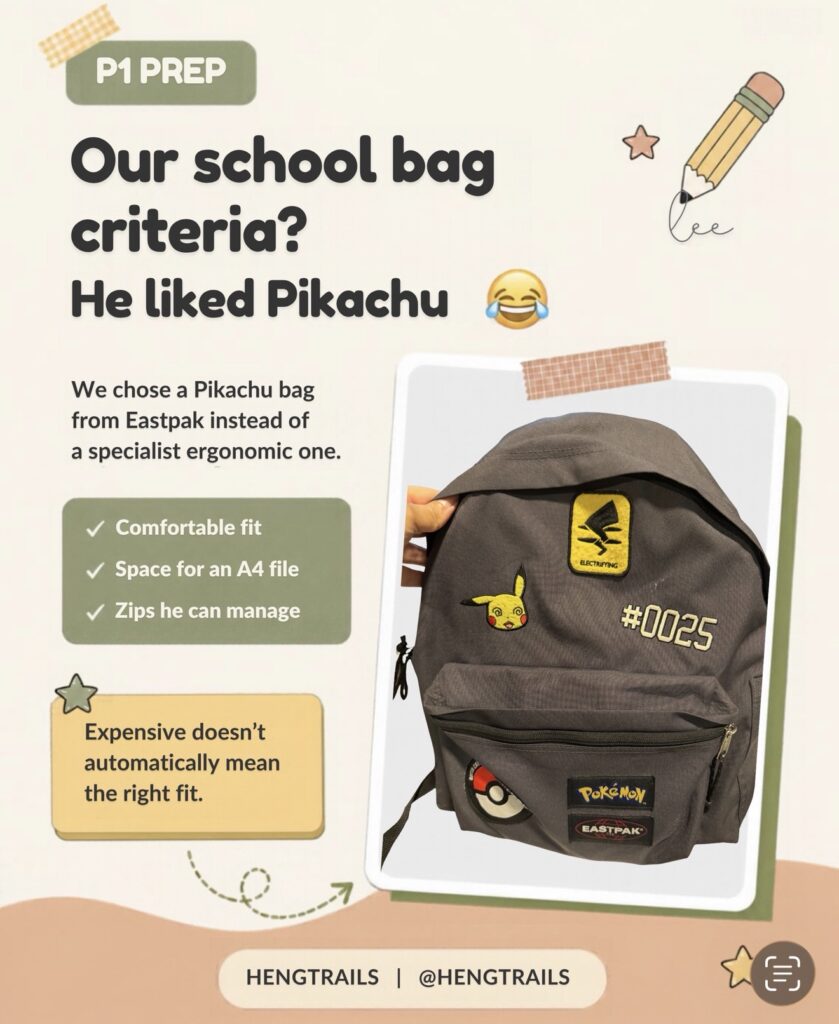
We chose a Pikachu bag from Decathlon, but I know some parents prefer a ergonomic school bag designed with more support and adjustment features. We haven’t personally tested the options below, so these are alternatives to explore rather than our own reviews. Where possible, let your child try the bag on and compare its empty weight, fit, capacity and ease of use before deciding.
1. IMPACT by Ergoworks
IMPACT comes up in Singapore parent discussions about school bags. The range includes different sizes and designs, so I would compare individual models rather than choose based on the brand alone.
Some parents report a comfortable fit, while others mention concerns about weight. Check how the bag feels on your child with their everyday supplies inside.
2. Dr. Kong
Dr. Kong is another brand mentioned by Singapore parents. Its backpack range includes models with adjustable straps, organised compartments and a waist belt.
Try the appropriate size on your child and check that they can manage the openings and straps independently. Don’t automatically buy a bigger size just so it can “last longer”.
3. ergobag
ergobag offers several school-bag designs, including the pack, cubo and cubo light. Its models feature chest and hip straps, with differences in shape, carrying systems and weight.
Check the exact model and version before buying: weights shown in older reviews or local listings may differ from the current range.
4. Tiger Family
Tiger Family is another option to compare, with ranges such as Jump, Jazzy and Joy.
For reference, its Singapore listings describe the Jump Flex Lightning Strike as approximately 800g and the Joy Pro 2S Splash of Ocean as approximately 900g. These figures are specific to those models, so check the listing for the bag you’re considering.
Explore Tiger Family school bags.
My take? Compare the fit, empty weight, space for school supplies and how easily your child can use it. An impressive feature list is only useful if the bag works for your child’s everyday routine.
And whichever bag you choose, pack only what they need that day. We’re sending them to school, not on a three-day expedition. 😂
Before buying a school bag for Primary 1, check:
- Can your child wear it comfortably?
- Does it fit the required books and an A4 file?
- Can your child open and close the zips?
- Can they find their belongings easily?
- Is it manageable when packed for an ordinary school day?
Try it on your child where possible, and check the school’s guidance before choosing a trolley-style bag.
You don’t need to dismiss every expensive bag, but you also don’t need to feel that an expensive one is compulsory.
Our priority: a suitable bag he was happy to carry.
2. Pencil Case or Pencil Pouch: Keep It Simple
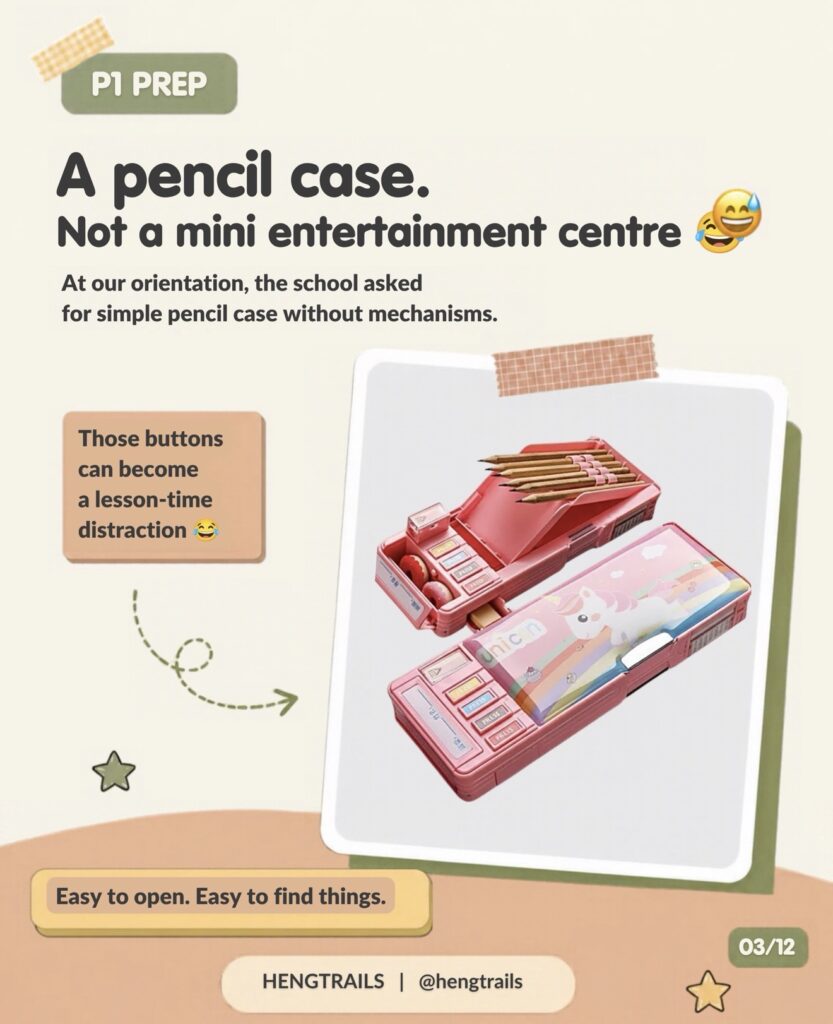
At our orientation, the school asked us to prepare simple pencil cases without mechanisms because children might play with those features during lessons.
Honestly, understandable. If I were six and my pencil case had buttons, secret compartments and things that popped out, I would want to investigate them too. 😂
A simple pencil case or pencil pouch can still be cheerful and cute. Look for one that your child can open independently and search through easily.
Before school starts, ask your child to take out a pencil, find the eraser and put everything back. That little practice tells you more than a product photo does.
3. Pencils, Eraser and Ruler: Personalised Stationery Saved Me Some Work
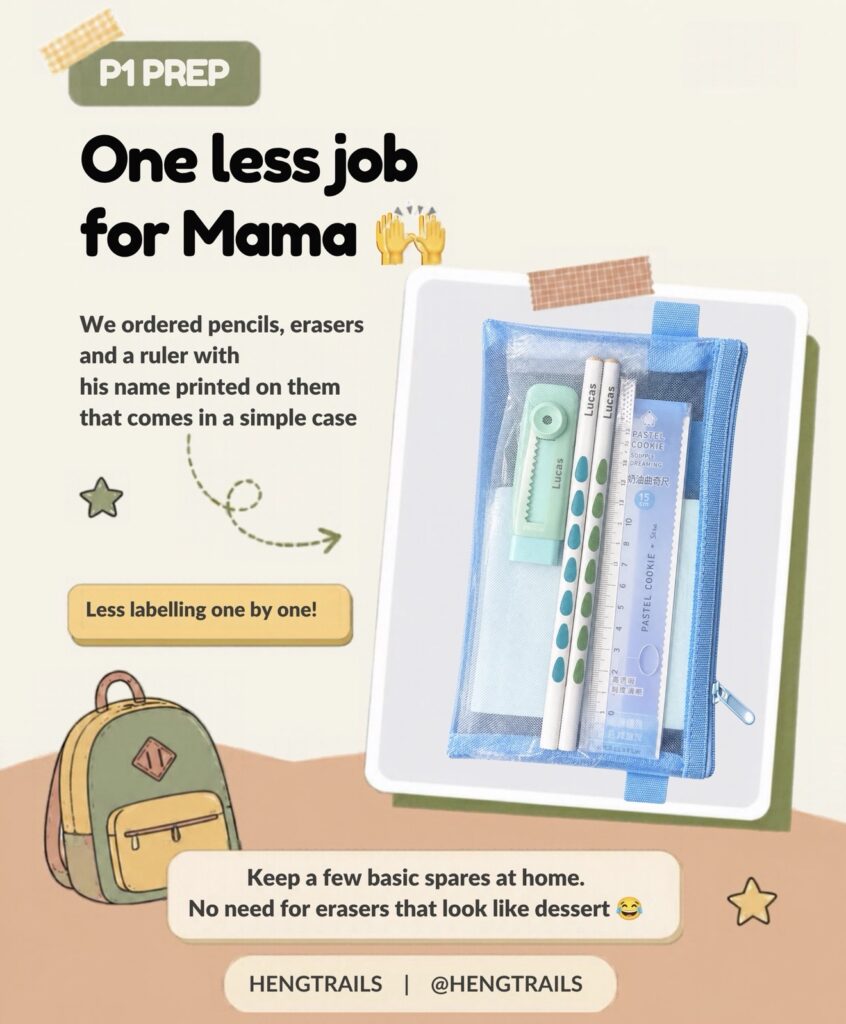
We ordered pencils, erasers and a ruler with his name printed on them, so I didn’t have to label each item individually.
For me, that was the practical benefit: one less small job during P1 preparation.
Names don’t make stationery impossible to lose. A pencil can still decide to go on its own adventure. 😂 But clear identification makes belongings easier to recognise.
Check the pencil type and quantities your school requests before ordering. Keep a few replacements at home rather than filling the pencil case with an oversized backup supply.
We got a personalised stationery set at Bezecrafts, with a pouch, two personalised pencils, an eraser and a ruler. It’s an option if you prefer the naming already done.
Personalisation takes time, so check the current ordering and delivery information before purchasing.
[Recommendation: Bezecrafts personalised stationery set]
Ordinary stationery with clear name labels works too. Choose whichever suits your budget and preparation time.
4. Pencil Sharpener with Container: Useful for the School Pencil Case
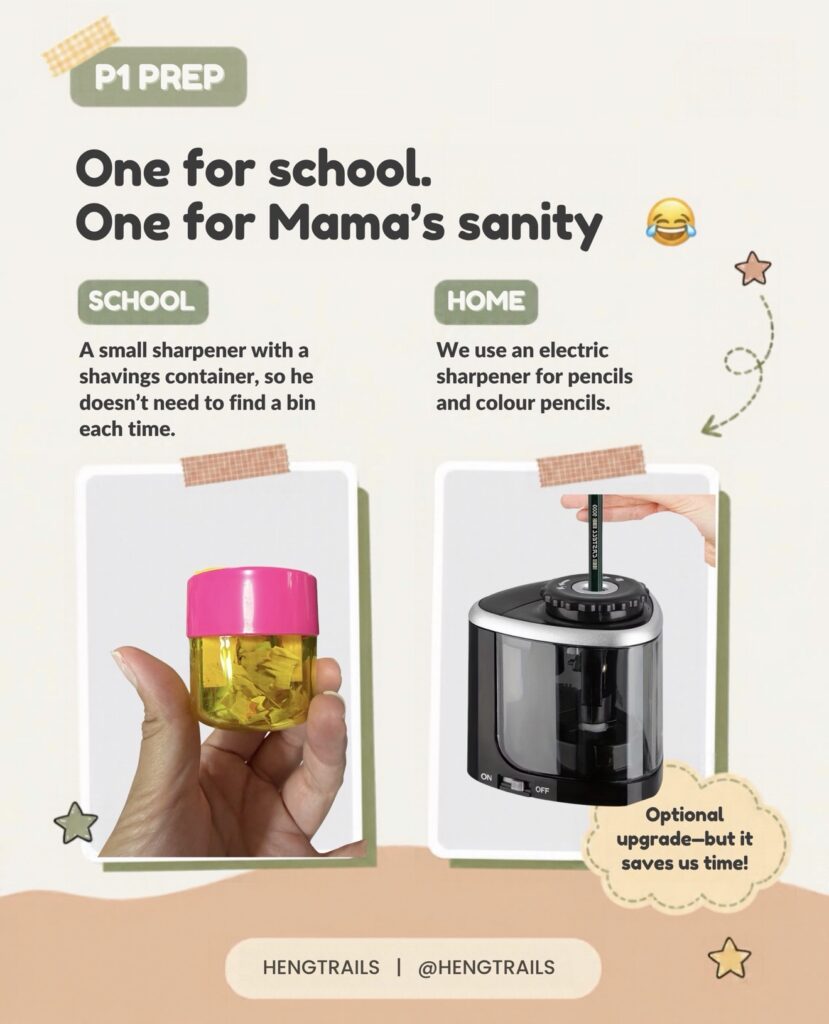
We bought a small pencil sharpener with a container for his pencil case.
The container holds the shavings until they can be emptied, so he doesn’t need to find a dustbin each time he sharpens a pencil.
Check that your child can:
- Hold and use the sharpener comfortably.
- Open the container.
- Empty it without spilling the contents.
- Close it properly afterwards.
Keep it compact and follow any school instructions about stationery.
Is an Electric Sharpener Necessary at Home?
No—but we found ours useful.
Between writing pencils and colour pencils, sharpening can become another evening task. An electric sharpener saves us time, which is why I call it the “Mama’s sanity” purchase. 😂
If your manual sharpener works well, there is no need to replace it. If you choose an electric one, check its suitability for your pencils and follow the manufacturer’s instructions.
[Recommendation: Electric Pencil sharpener]
5. Colour Pencils: Buy the Set the School Requests
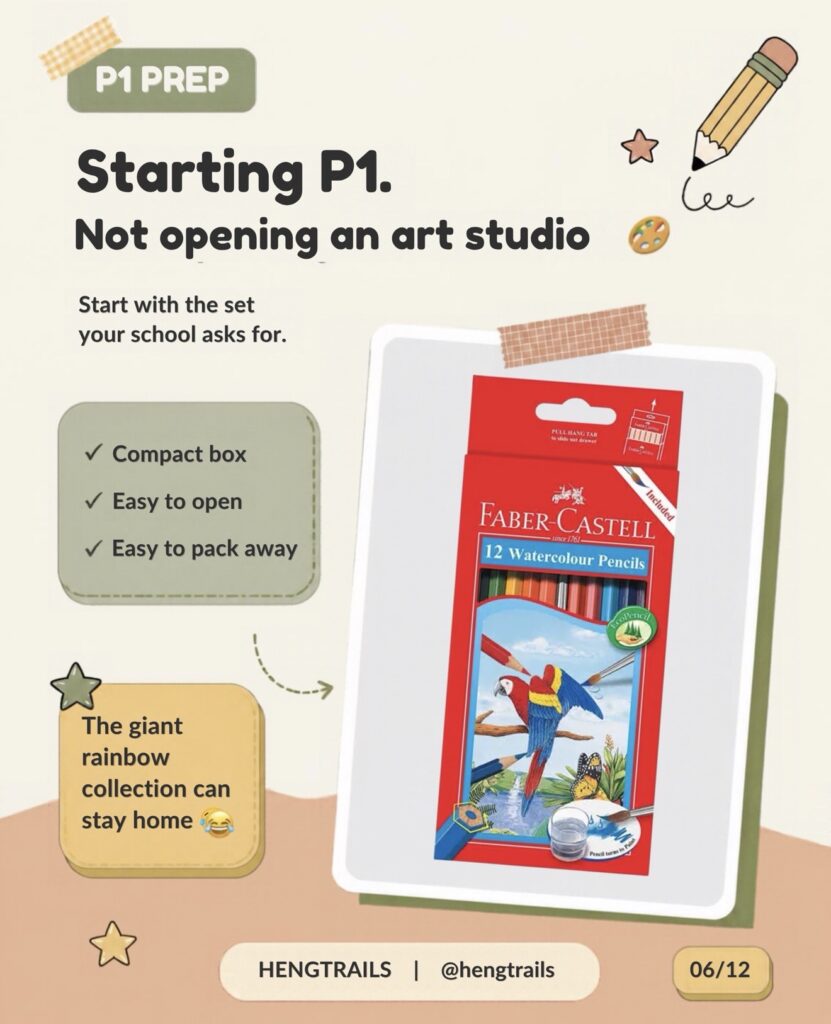
Start with the school’s requested set rather than the largest collection you can find.
I would prioritise a compact box that your child can open and pack away independently. Let them practise returning the pencils to their places before school begins.
Check your existing supplies too. A suitable set from home may be enough.
The giant rainbow collection can stay at home for art time. They’re starting P1, not opening an art studio. 😂
6. Homework Folders and Files: Give Loose Papers a Home
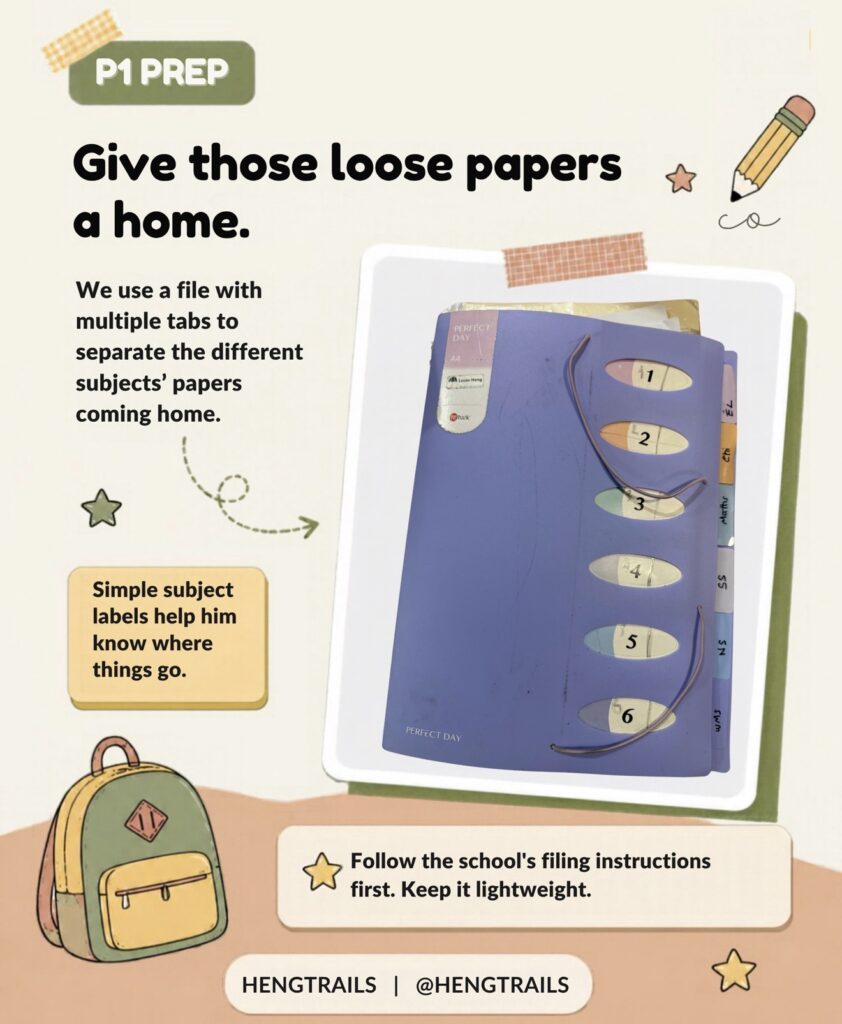
We use a file with multiple tabs to separate the different subjects’ papers coming home.
It gives loose worksheets a place to go instead of letting them collect at the bottom of the school bag.
When choosing homework folders or files, keep the system simple enough for your child to use. Clear subject labels can help, and you can practise sorting a few sample papers together.
However, follow the school’s filing instructions first. If teachers request specific subject files or a particular homework folder, use that system.
A multi-tab file is helpful only if it fits the routine. You don’t need a second bulky filing system competing with the school’s one.
[Recommendation: Multi-tab file or homework folder]
7. Lunch and Snack Boxes: Can Your Child Open Them?
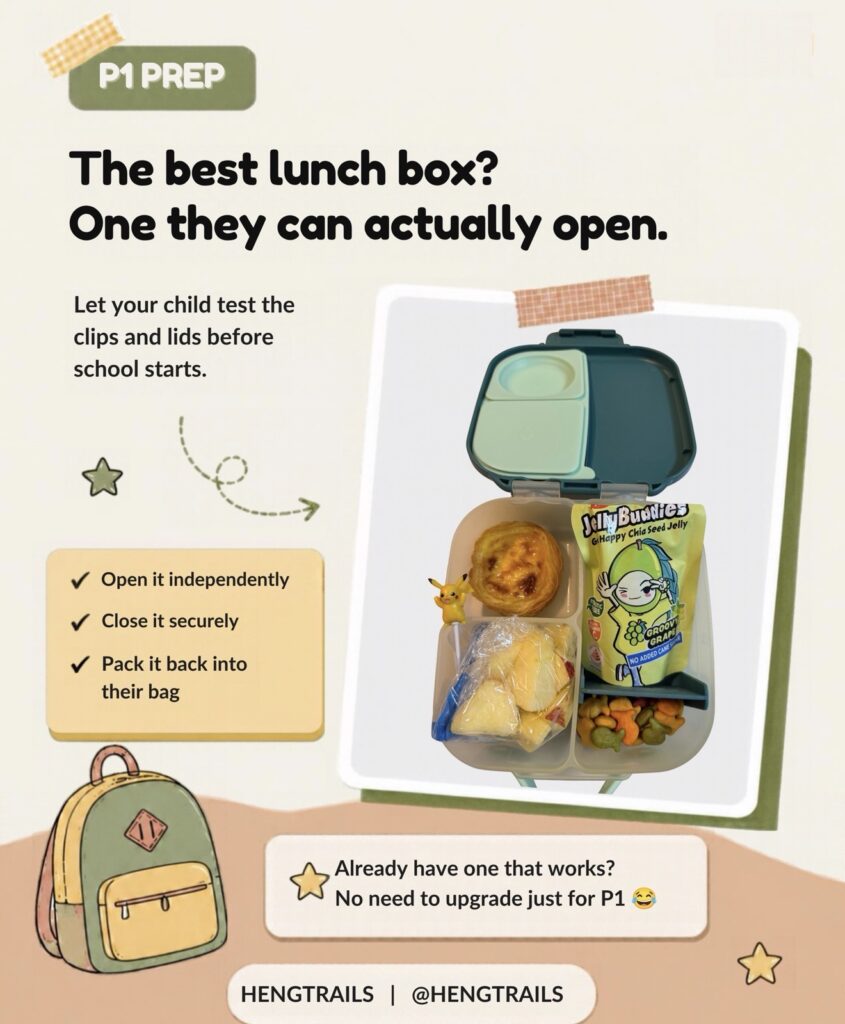
During roughly the first month of P1, I packed food for both recess and snack break.
My boy already had plenty of new things to manage, so I was happy for buying food independently to come gradually.
The most important lunch-box test is simple:
Can your child open it without your help?
Let them practise opening the clips, taking out the food, closing the container and putting it back into their bag.
Also consider:
- Whether it suits the portions and food you pack.
- Its weight when filled.
- Whether it fits comfortably in the bag.
- Any school snack-break instructions.
If your preschool lunch box still works, keep using it. It doesn’t suddenly become unsuitable just because your child is in primary school.
[Recommendation: P1 lunch-box pick].
8. Wallet: Make Coins, Notes and Change Easy to Manage
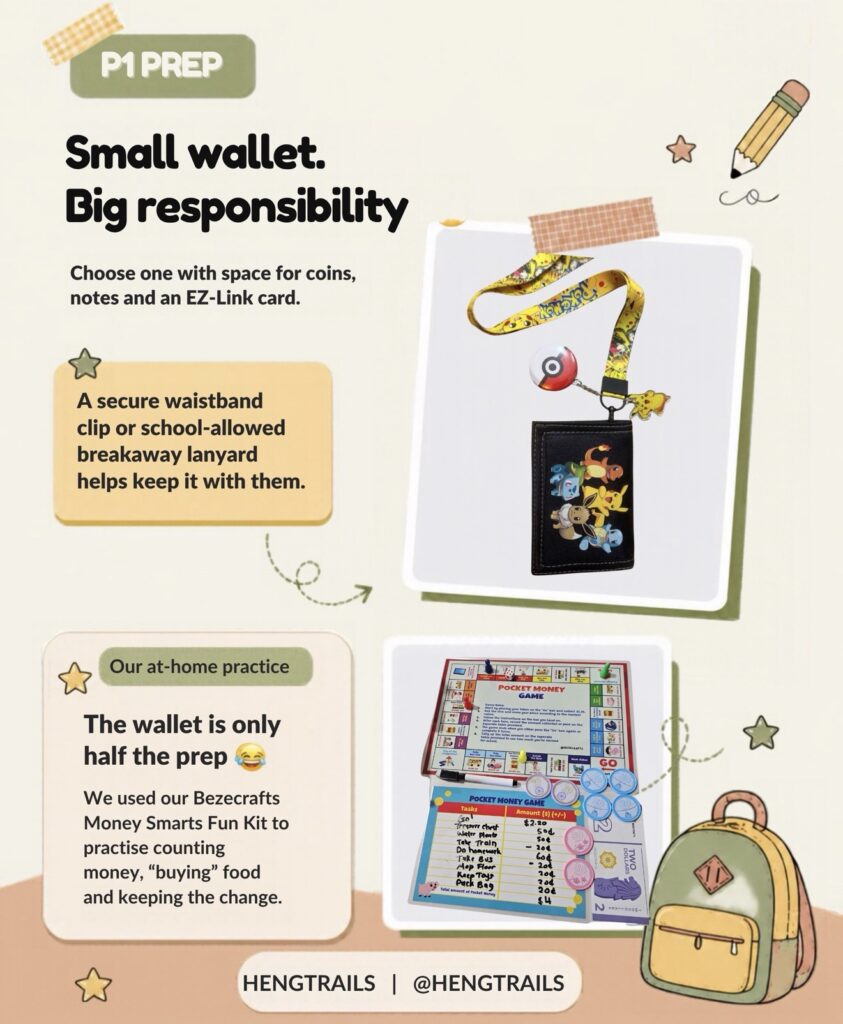
[llet showing its attachment and compartments]
Look for a wallet with space for coins, notes and an EZ-Link card if your child carries one.
Check that the coin compartment is easy to access and closes securely. A secure waistband or belt-loop clip can help keep the wallet with your child.
If you prefer a lanyard, check the school’s rules and choose an appropriate breakaway design.
Then practise the entire purchase sequence:
- Take the wallet out.
- Find the money.
- Pay.
- Receive and put away the change.
- Close and secure the wallet.
Those steps may seem small to us, but they are part of handling money independently.
[Recommendation: Our P1 wallet]
Practising Money Skills Before P1
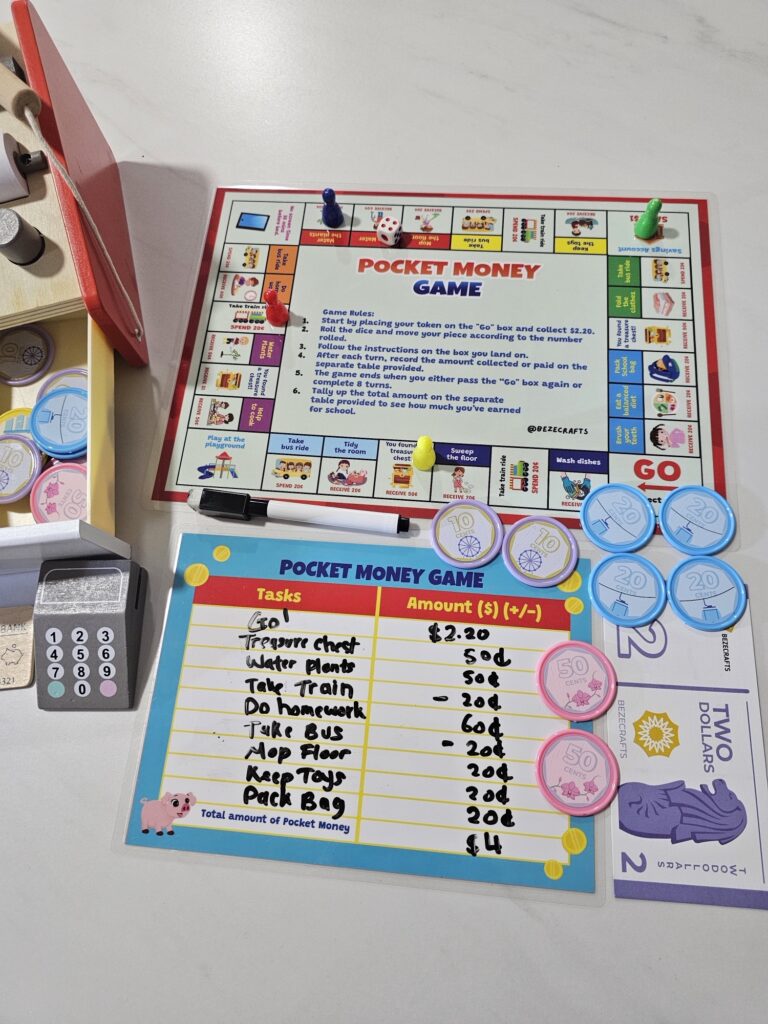
The wallet is only half the preparation. Knowing what to do with the money inside is the other half!
We started with real cash before moving to cashless payment because I wanted our boy to understand the coins and notes he was using.
At home, we used our Bezecrafts Money Smarts Fun Kit for money practice and canteen or bookshop role-play. It lets us practise recognising money, making purchases and working out change through play.
You can also set up a pretend shop using handwritten price tags and things you already own. Start with simple amounts and build up gradually.
If you prefer a ready-made resource, explore Bezecrafts Money Smarts Fun Kit.
This is an optional activity from our own shop, rather than a school requirement.
9. Water Bottle: Practise Remembering to Drink Too
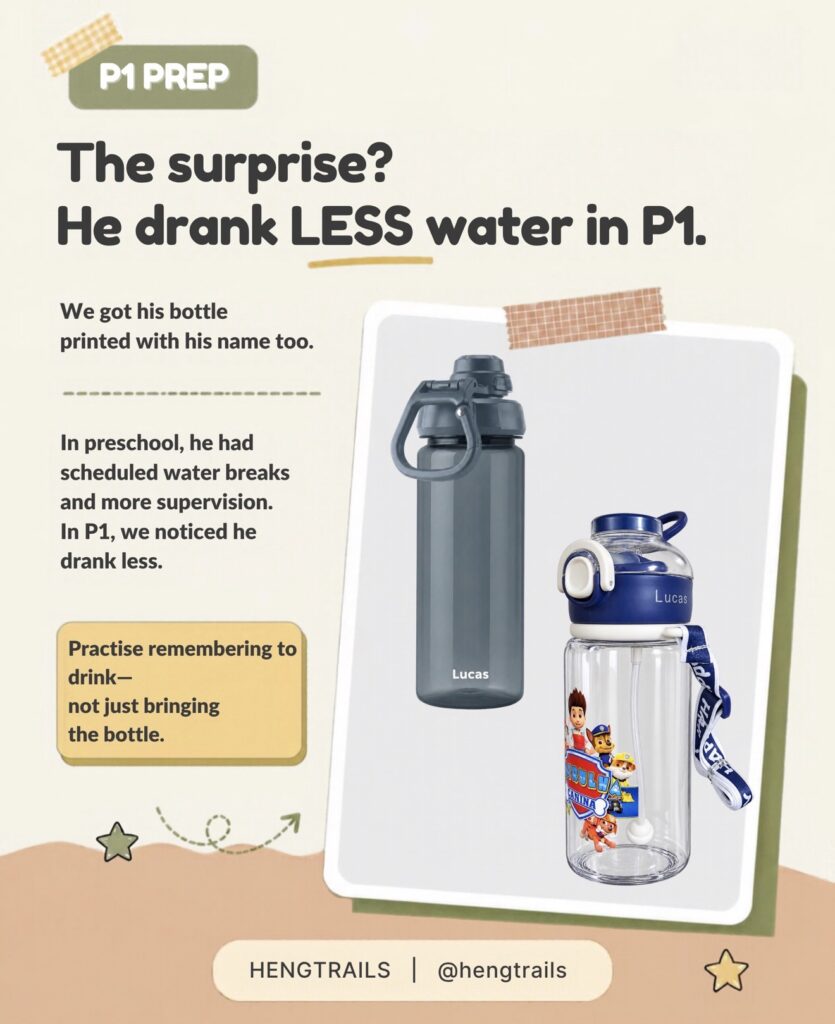
We got his water bottle printed with his name as well.
One thing I didn’t expect was that he drank less water after starting P1. In preschool, he had scheduled water breaks and more teacher supervision.
That was our experience; routines will differ between schools and classes.
Choose a bottle your child can open, drink from and close properly. Check that it is manageable to carry when filled and easy to identify.
Practise using it before school starts, and ask about opportunities to drink and refill during the school day.
Bringing the bottle is one thing. Remembering to drink is another!
[Recommendation: Our personalised water bottle]
10. Small School Supplies That Are Easy to Forget
A few everyday extras are worth checking:
- Name labels: For belongings that aren’t already personalised.
- Pocket tissues: Show your child where they are kept and how to replace them.
- School shoes: Follow school requirements and practise fastening them.
- Reading book: Pack the requested type or language if specified.
- Uniforms and PE attire: Confirm the correct requirements before ordering.
For labels, use the identifying information your school requests. Help your child recognise their own items rather than relying only on adults to find the names.
What School Supplies Can You Reuse or Skip?
Before buying anything new, check whether your current belongings are suitable.
A working lunch box, manageable bottle, simple pencil case or comfortable bag may still be useful.
I wouldn’t rush to buy:
- A huge colour-pencil collection for school.
- Novelty stationery with lots of moving parts.
- Several spare bags or lunch boxes before understanding the routine.
- Extra files that don’t match the school’s instructions.
- An electric sharpener if your manual one works well.
Books and school-specific materials should follow the official booklist. Keep that ordering process separate from your everyday shopping checklist.
Before School Starts: Try a P1 School-Bag Practice Run
Once the essentials are ready, let your child practise with them.
Pack the bag together. Ask them to find the pencil case, open the lunch box, use the water bottle and put everything away.
This can reveal an awkward zip or difficult lid while there is still time to adjust.
Keep it light and familiar. You’re helping them get comfortable with their belongings, rather than giving them another test to pass.
Frequently Asked Questions About Primary 1 School Supplies
What school supplies does a Primary 1 child need in Singapore?
Check your school’s list first. Everyday basics commonly include a school bag, stationery, a file, water bottle and wallet. Lunch or snack containers, reading books and other items depend on school instructions and your child’s routine.
Does my child need an expensive school bag?
We didn’t buy one, but each child’s needs differ. Prioritise fit, manageable weight, capacity and ease of use rather than price alone.
What should be inside a P1 pencil case?
Follow the school’s stationery list. Basic items often include pencils, an eraser, ruler and sharpener, but quantities and pencil types may differ.
Is personalised stationery necessary?
No. We found it convenient because it saved individual labelling. Ordinary stationery with clear name labels is another practical option.
Do I need to buy all new back to school supplies?
No. Reuse suitable items your child can manage, and replace only what is missing, worn out or unsuitable for the school’s requirements.
Our P1 Shopping Links and More Preparation Tips
Preparing for P1 doesn’t need to mean buying the fanciest version of everything.
Start with your school’s instructions, check what you already own, and choose belongings your child can use independently.
Browse our P1 school supplies collection for our picks and recommendations.
For the wider transition, read my complete K2 to Primary 1 guide, and follow @hengtrails on Instagram for more practical experiences from our family.
What was your most useful P1 purchase—and what could you have skipped? Share it in the comments so other parents can learn from your experience too.